
Parancistrocerus texensis
de Saussure, 1871
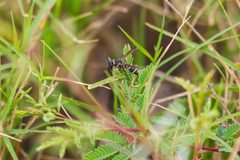
Parancistrocerus texensis is a of solitary mason wasp in the Eumeninae. It is one of numerous small, cavity-nesting in the Parancistrocerus that provision their larvae with paralyzed caterpillars. The species was described by Henri de Saussure in 1871, with the epithet suggesting a Texas origin. Like other members of its genus, it is difficult to distinguish from without microscopic examination, and is frequently confused with similar genera such as Stenodynerus.
Pronunciation
How to pronounce Parancistrocerus texensis: /ˌpær.ənˌsɪs.trəˈsiː.rəs tɛkˈsɛn.sɪs/
These audio files are automatically generated. While they are not always 100% accurate, they are a good starting point.
Identification
Parancistrocerus texensis is extremely difficult to distinguish from and from the related Stenodynerus based on field observations alone. Even with specimens under a microscope, identification to level requires expert examination. Members of Parancistrocerus are small mason wasps with wing lengths typically in the 6-10 mm range. The genus is characterized by features of the propodeum and sternal structure that separate it from similar eumenine . For reliable identification, reference to specialized keys for Nearctic Vespidae, such as those developed by Matthias Buck and colleagues, is necessary.
Images
Habitat
As a cavity-nesting mason wasp, Parancistrocerus texensis utilizes pre-existing tunnels in dead wood, hollow twigs, or borings. Artificial nest blocks with drilled holes of appropriate diameter are readily occupied. The requires access to sandy or clayey soil for nest partition construction, as females craft walls from sand particles cemented with saliva.
Distribution
The specific distribution of Parancistrocerus texensis is not well documented in the provided sources. The epithet suggests Texas as part of its range. The Parancistrocerus as a whole is widespread in North America, with numerous species occurring across the continent.
Diet
females hunt caterpillars to provision larval . The specific prey preferences for P. texensis are not documented in available sources. Related in the are known to target small caterpillars, particularly those of microlepidoptera.
Life Cycle
Females divide pre-existing cavities into multiple , constructing partitions from sand and saliva. Each cell is provisioned with a series of paralyzed caterpillars, with a single laid on the final victim. The cell is then sealed before the next is prepared. Larvae consume the provided prey and pupate within the cell. The details specific to P. texensis are not documented.
Behavior
Females exhibit solitary nesting , utilizing existing cavities rather than excavating their own. They demonstrate prey-specific hunting for caterpillars and precise nest construction behavior involving the crafting of sand-based partitions. Males may be observed nectaring at flowers or establishing territories near nesting .
Ecological Role
As a of caterpillars, Parancistrocerus texensis contributes to natural regulation of herbivorous insect . The also participates in pollination through nectar-feeding at flowers. Its cavity-nesting makes it a component of the dead wood .
Human Relevance
Parancistrocerus texensis and related mason wasps are beneficial insects in gardens and natural landscapes due to their caterpillar . They readily occupy artificial blocks and nest boxes, making them observable subjects for citizen science and natural history study. They are not aggressive and pose minimal sting risk to humans.
Similar Taxa
- Stenodynerus spp.Extremely similar in appearance and ; frequently impossible to distinguish from Parancistrocerus in live specimens or images. Microscopic examination of sternal and genitalic characters is typically required for separation.
- Parancistrocerus perennisA congeneric with overlapping range and nearly identical . P. perennis is known from southern Ontario to Florida and west to the Mississippi River, and is distinguished by subtle structural features not visible in field conditions.
- Euodynerus spp.Related eumenine mason wasps of similar size and general appearance. Euodynerus often show more contrasting color patterns and have different propodeal structure.
More Details
Taxonomic Note
The Parancistrocerus is part of a complex of small eumenine that have undergone repeated taxonomic revision. boundaries are often subtle and require detailed morphological analysis. The online identification guide to Nearctic Vespidae by Buck et al. represents the most current resource for species-level identification.
Nesting Biology
Parancistrocerus exemplify the 'sand wasp' strategy of nest construction within pre-existing cavities, contrasting with ground-nesting relatives. The use of sand-saliva partitions is a diagnostic behavioral trait of the and allies.