
Parancistrocerus declivatus
(Bohart, 1948)
potter wasp
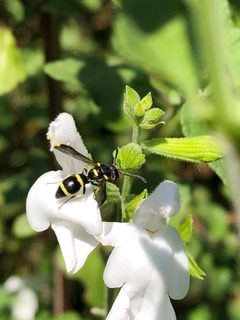
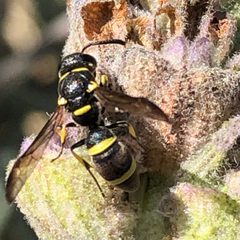
Parancistrocerus declivatus is a potter wasp in the Vespidae, native to the southern coastal regions of California and Baja California. Originally described in the Stenodynerus, it was later transferred to Parancistrocerus. The type locality is La Laguna in the Sierra Laguna mountains of Baja California. Like other members of the Eumeninae, it is a solitary that constructs nests from mud or other materials.
Pronunciation
How to pronounce Parancistrocerus declivatus: //ˌpærənˌsɪstroʊˈsɪərəs dɪˌklaɪˈveɪtəs//
These audio files are automatically generated. While they are not always 100% accurate, they are a good starting point.
Identification
Parancistrocerus declivatus can be distinguished from similar mason wasps by geographic range, as it is restricted to southern California and Baja California. It was formerly placed in Stenodynerus, and separation from that and from other Parancistrocerus requires examination of subtle morphological characters. The genus Parancistrocerus is distinguished from Stenodynerus by features of the propodeum and petiole structure, though these require microscopic examination for reliable determination.
Images
Habitat
Coastal regions of southern California and Baja California, including areas near La Laguna in the Sierra Laguna mountains. The type locality suggests association with mountainous coastal .
Distribution
Southern coastal counties of California, USA, and Baja California, Mexico. The type locality is La Laguna, Sierra Laguna, Baja California.
Life Cycle
As a member of the Eumeninae, females construct nests in pre-existing cavities such as hollow twigs or borings, provisioning with paralyzed caterpillars as food for larvae. However, specific details for P. declivatus have not been documented.
Ecological Role
As a solitary predatory , likely functions as a agent of caterpillars in its native range. The Eumeninae is known for provisioning nests with Lepidoptera larvae.
Similar Taxa
- Stenodynerus spp.P. declivatus was originally described in this and shares general mason wasp ; separation requires examination of structural characters
- Parancistrocerus perennisAnother small Parancistrocerus , but with eastern distribution (Ontario to Florida, west to Mississippi River), differing in geographic range and possibly coloration
- Euodynerus spp.Similar mason wasps in the same , often found in the same region, but differing in nest structure and specific morphological details
More Details
Taxonomic history
Originally described as Stenodynerus declivatus by Bohart in 1948, this was later transferred to Parancistrocerus based on revised understanding of generic limits within the Eumeninae.
Type locality
The was collected at La Laguna in the Sierra Laguna mountains of Baja California, establishing the southern extent of its known range.