
Ancistrocerus catskill
(de Saussure, 1853)
Ancistrocerus catskill is a solitary mason wasp in the Eumeninae, native to the northeastern United States. The constructs nests in pre-existing cavities such as hollow stems, borings in wood, or abandoned mud dauber nests. Females provision nests with paralyzed caterpillars as food for their developing larvae. The species name references the Catskill Mountains region of New York, where it was first described.
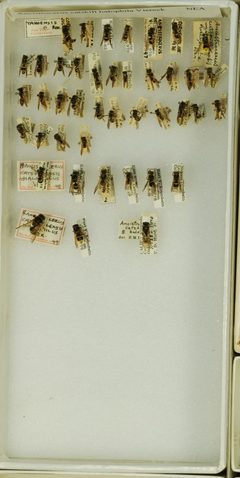
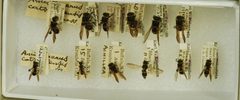
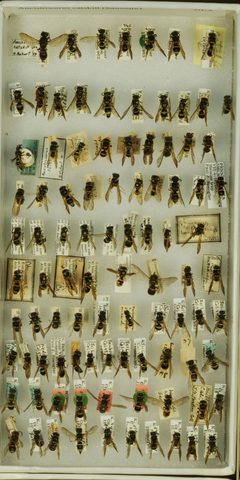
Pronunciation
How to pronounce Ancistrocerus catskill: /ænˌsɪstroʊˌserəs ˈkætskɪl/
These audio files are automatically generated. While they are not always 100% accurate, they are a good starting point.
Identification
Ancistrocerus catskill can be distinguished from similar mason wasps by the presence of a prominent transverse carina (ridge) on the base of the first abdominal segment (T1), creating an abrupt angle facing the rear of the —a diagnostic feature of the Ancistrocerus. Specific markings for A. catskill are not well documented in available sources, though related in the genus typically display black bodies with yellow, white, or rusty orange markings. The species is smaller than social and lacks the robust build of yellowjackets.
Images
Habitat
Found in woodland edges and forested areas, particularly in regions with mixed hardwood forest. Nests in pre-existing cavities including hollow plant stems, borings in dead wood, sumac twigs, and abandoned mud dauber nests.
Distribution
Northeastern United States; specifically recorded from Vermont and the conterminous 48 United States. The name derives from the Catskill Mountains region of New York.
Behavior
Females are solitary nesters that partition pre-existing cavities into individual using mud. They hunt caterpillars, sting them to induce paralysis, and cache multiple prey items per cell. The is typically laid in an empty cell before provisioning, then suspended from the cell roof by a silken thread. The paralyzed caterpillars remain alive but immobile, providing fresh food for the developing larva.
Ecological Role
of caterpillars (primarily larvae), contributing to natural control of herbivorous insects. As a cavity-nesting , it utilizes abandoned structures made by other insects, participating in of dead wood .
Similar Taxa
- Ancistrocerus waldeniiAlso constructs mud nests attached to hard surfaces, but A. waldenii specifically builds free-form mud cylinders on rocks, concrete, or flower pots rather than using pre-existing cavities.
- Ancistrocerus unifasciatusSimilar size and cavity-nesting , but A. unifasciatus has distinct yellow markings limited to the , base, base, and legs; males have a large yellow facial patch.
- Ancistrocerus campestrisOverlapping range and similar use, but A. campestris has yellow hind margins on the first three abdominal segments and preys on different caterpillar (Amphisbatidae and Gelechiidae).
Sources and further reading
- BugGuide
- GBIF taxonomy match
- iNaturalist taxon
- NCBI Taxonomy
- Catalogue of Life
- Bug Eric: Wasp Wednesday: Walden's Mason Wasp, Ancistrocerus waldenii
- Bug Eric: How to (Almost) Catch a Leaf-tier Caterpillar (Video)
- Bug Eric: How to Catch a Leafroller Caterpillar (Video)
- Suitable Range for Spotted Lanternfly Refined in New Study
- Bug Eric: Eight Illinois Wasp and Bee Mimics in Twenty Minutes
- Bug Eric: Louse Flies? Are You "Ked"-ing Me?