
Rhopalosoma
Cresson, 1865
cricket parasitoid wasps
Species Guides
1Rhopalosoma is a of in the Rhopalosomatidae, comprising 18 described distributed primarily in the Neotropics and southern Nearctic. Larvae develop as ectoparasitoids of crickets (Orthoptera: Gryllidae, Trigonidiidae), attaching externally to nymphs or . Adults are rarely encountered in the field and are among the least known of all wasps. Genetic studies indicate the presence of cryptic , with at least two genetically distinct lineages present in America north of Mexico.
Pronunciation
How to pronounce Rhopalosoma: //ˌroʊpæloʊˈsoʊmə//
These audio files are automatically generated. While they are not always 100% accurate, they are a good starting point.
Identification
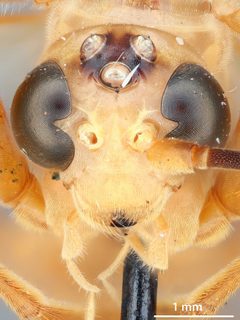
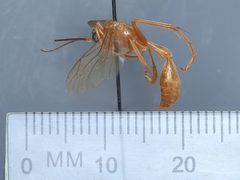
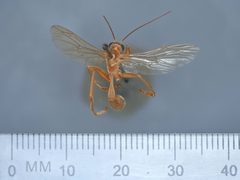
can be distinguished from other Rhopalosomatidae by the combination of a well-developed pterostigma, absence of a distinct pronotal collar, and forewing venation with two or three closed . The is morphologically intermediate between the Olixon and Paniscomima lineages. -level identification relies primarily on male genitalia and wing venation patterns; females of many species remain difficult to identify. Fossil specimens from Dominican and Mexican amber show morphological intermediacy between the isopus and poeyi species groups.
Images
Habitat
have been collected in nature parks and forested areas with abundant . The appears to favor humid, vegetated environments where are accessible. Specific microhabitat preferences for adult activity remain poorly documented due to the rarity of field observations.
Distribution
Pantropical and southern Nearctic distribution. Documented from the Caribbean (Hispaniola, Haiti), Central America (Mexico), and South America (Brazil, Bolivia, Guyana). In America north of Mexico, R. nearcticum is the only formally documented , though genetic evidence indicates at least one additional undescribed species is present. Fossil records from Dominican amber (Miocene) and Mexican amber document historical presence in the Caribbean and Mesoamerica.
Host Associations
- Hapithus agitator - ectoparasitoidGryllidae: Hapithinae; documented of R. nearcticum
- Hapithus brevipennis - ectoparasitoidGryllidae: Hapithinae; documented of R. nearcticum
- Hapithus saltator - ectoparasitoidGryllidae: Hapithinae; documented of R. nearcticum
- Anaxipha exigua species-group - ectoparasitoidTrigonidiidae: Trigonidiinae; new record for Rhopalosoma, discovered via larval in Tennessee
Life Cycle
Larvae are ectoparasitoids that attach externally to crickets and feed on . Development occurs on the host body; mature larvae presumably drop to the soil to pupate, though has not been directly observed for most . timing and longevity are unknown.
Behavior
are or and rarely observed in . Females presumably locate by searching vegetation or soil surface where crickets occur. Larval stages remain attached to hosts for extended periods, with multiple larvae sometimes found on a single cricket individual.
Ecological Role
Ectoparasitoid of crickets, potentially regulating orthopteran in tropical and subtropical . The specialized association suggests coevolutionary relationships with lineages, though population-level impacts on host abundance remain unstudied.
Similar Taxa
- OlixonAlso in Rhopalosomatidae; distinguished by reduced wing venation with fewer closed and different pronotal structure
- PaniscomimaAlso in Rhopalosomatidae; distinguished by more elongate body form and different wing configuration
Sources and further reading
- BugGuide
- Wikipedia
- GBIF taxonomy match
- iNaturalist taxon
- NCBI Taxonomy
- Catalogue of Life
- Notes on the Biology and Immature Stages of a Cricket Parasite of the Genus Rhopalosoma
- DNA barcoding of rhopalosomatid larvae reveals a new host record and genetic evidence of a second species of Rhopalosoma Cresson (Hymenoptera, Rhopalosomatidae) in America north of Mexico
- Habitat abundances of a cricket-parasitizing wasp <i>Rhopalosoma nearcticum</i> (Hymenoptera: Rhopalosomatidae) in a United States mid-Atlantic park
- Notes on rhopalosomatid wasps of Dominican and Mexican amber (Hymenoptera: Rhopalosomatidae) with a description of the first fossil species of <i>Rhopalosoma</i> Cresson, 1865
- Figure 1 from: Miller LA, Benefield TD, Lounsbury SA, Lohrmann V, Blaschke JD (2019) DNA barcoding of rhopalosomatid larvae reveals a new host record and genetic evidence of a second species of Rhopalosoma Cresson (Hymenoptera, Rhopalosomatidae) in America north of Mexico. Journal of Hymenoptera Research 74: 35-46. https://doi.org/10.3897/jhr.74.38276
- Figure 3 from: Miller LA, Benefield TD, Lounsbury SA, Lohrmann V, Blaschke JD (2019) DNA barcoding of rhopalosomatid larvae reveals a new host record and genetic evidence of a second species of Rhopalosoma Cresson (Hymenoptera, Rhopalosomatidae) in America north of Mexico. Journal of Hymenoptera Research 74: 35-46. https://doi.org/10.3897/jhr.74.38276
- Figure 2 from: Miller LA, Benefield TD, Lounsbury SA, Lohrmann V, Blaschke JD (2019) DNA barcoding of rhopalosomatid larvae reveals a new host record and genetic evidence of a second species of Rhopalosoma Cresson (Hymenoptera, Rhopalosomatidae) in America north of Mexico. Journal of Hymenoptera Research 74: 35-46. https://doi.org/10.3897/jhr.74.38276
- Figure 4 from: Miller LA, Benefield TD, Lounsbury SA, Lohrmann V, Blaschke JD (2019) DNA barcoding of rhopalosomatid larvae reveals a new host record and genetic evidence of a second species of Rhopalosoma Cresson (Hymenoptera, Rhopalosomatidae) in America north of Mexico. Journal of Hymenoptera Research 74: 35-46. https://doi.org/10.3897/jhr.74.38276
- Figure 5 from: Armstrong AL, Sones JE, Lohrmann V, Hebert PDN, Janzen DH, Hallwachs W, Blaschke JD (2024) Six in one: cryptic species and a new host record for Olixon Cameron (Rhopalosomatidae, Hymenoptera) revealed by DNA barcoding. Journal of Hymenoptera Research 97: 363-378. https://doi.org/10.3897/jhr.97.116726