
Olixon
Cameron, 1887
Species Guides
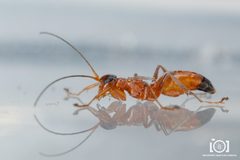
2Olixon is a of solitary in the Rhopalosomatidae, established by Cameron in 1887. All known are brachypterous (short-winged) ectoparasitoids of crickets, primarily in the family Gryllidae. The genus is distributed across the African, Australian, and American continents, with a notable concentration of diversity in Australia. Species are generally considered rare in collections and infrequently observed in the field.
Pronunciation
How to pronounce Olixon: //oʊˈlɪksɒn//
These audio files are automatically generated. While they are not always 100% accurate, they are a good starting point.
Identification
Key diagnostic features include brachypterous wings, straight inner margins, and body proportions. -level identification requires examination of carinae (particularly apicolateral carina), vertex impressions, and male genitalia. Australian species form the majority of described diversity and require specialized keys; at least six cryptic species have been identified within the widespread O. testaceum complex using .
Images
Habitat
Found in diverse terrestrial including Restinga coastal vegetation, Pantanal wetlands, and tropical to temperate woodlands. Specific microhabitat associations are poorly documented due to rarity in field observations.
Distribution
Widespread but disjunct: Australia (17+ , center of diversity), Africa including Madagascar (first recorded 2024), India, and the Americas from southeastern Canada to central-eastern Argentina. Notable gaps in northeastern Brazil despite extensive Neotropical records.
Host Associations
- Gryllidae - ectoparasitoidprimary ; all known Olixon are ectoparasitoids of crickets
- Trigonidiidae - ectoparasitoidAnaxipha sp. documented as for O. testaceum through larval
Life Cycle
Solitary ectoparasitoid development on . Larvae feed externally on host crickets. Specific details of placement, larval instars, and sites are not documented.
Behavior
Solitary; brachypterous condition suggests limited capability and possible association with ground-dwelling or vegetation-dwelling . rarely encountered in field surveys.
Ecological Role
regulating . Potential use suggested by discovery of trigonidiid host, contrasting with earlier assumptions of gryllid specialization.
Similar Taxa
- RhopalosomaFully winged rhopalosomatid ; Olixon distinguished by brachypterous condition and straight inner margins
- PaniscomimaOther brachypterous rhopalosomatid ; Olixon distinguished by specific carinae and male genitalia characters
Misconceptions
Previously considered rare based on museum material, but recent intensive surveys in Australia revealed substantial undescribed diversity; rarity may reflect detection rather than true scarcity. O. testaceum was considered a single widespread but comprises at least six cryptic lineages.
More Details
Cryptic diversity
of O. testaceum revealed at least six distinct lineages, indicating extensive cryptic speciation. This has implications for range assessment and biogeographic interpretation.
Biogeography
Phylogenetic analysis indicates Australian are not monophyletic; approximately three-quarters form a clade with a Central/South American species as sister to all others, suggesting complex historical .
Taxonomic history
World fauna increased from 11 (2008) to 29+ species through Australian and Neotropical revisions. Madagascar fauna discovered 2024.
Sources and further reading
- BugGuide
- Wikipedia
- GBIF taxonomy match
- iNaturalist taxon
- NCBI Taxonomy
- Catalogue of Life
- The wasp genus Olixon Cameron in Madagascar: first record and description of two new species (Hymenoptera: Rhopalosomatidae)
- Recent Findings ofOlixon banksiiin the Nearctic with Notes on Its Biology (Hymenoptera: Rhopalosomatidae)
- A new species of Olixon Cameron, 1887 (Hymenoptera: Rhopalosomatidae) and new records for the genus in Brazil
- Six in one: cryptic species and a new host record for Olixon Cameron (Rhopalosomatidae, Hymenoptera) revealed by DNA barcoding
- Contributions to the knowledge of Olixon Cameron, 1887 (Hymenoptera, Rhopalosomatidae): a new species and new records of the genus for northeastern Brazil
- Systematics and biogeography of Australian rhopalosomatid wasps (Hymenoptera: Rhopalosomatidae) with a global synopsis of the enigmatic genus Olixon Cameron
- Figure 3 from: Armstrong AL, Sones JE, Lohrmann V, Hebert PDN, Janzen DH, Hallwachs W, Blaschke JD (2024) Six in one: cryptic species and a new host record for Olixon Cameron (Rhopalosomatidae, Hymenoptera) revealed by DNA barcoding. Journal of Hymenoptera Research 97: 363-378. https://doi.org/10.3897/jhr.97.116726
- Figure 6 from: Armstrong AL, Sones JE, Lohrmann V, Hebert PDN, Janzen DH, Hallwachs W, Blaschke JD (2024) Six in one: cryptic species and a new host record for Olixon Cameron (Rhopalosomatidae, Hymenoptera) revealed by DNA barcoding. Journal of Hymenoptera Research 97: 363-378. https://doi.org/10.3897/jhr.97.116726
- Figure 2 from: Armstrong AL, Sones JE, Lohrmann V, Hebert PDN, Janzen DH, Hallwachs W, Blaschke JD (2024) Six in one: cryptic species and a new host record for Olixon Cameron (Rhopalosomatidae, Hymenoptera) revealed by DNA barcoding. Journal of Hymenoptera Research 97: 363-378. https://doi.org/10.3897/jhr.97.116726
- Figure 1 from: Armstrong AL, Sones JE, Lohrmann V, Hebert PDN, Janzen DH, Hallwachs W, Blaschke JD (2024) Six in one: cryptic species and a new host record for Olixon Cameron (Rhopalosomatidae, Hymenoptera) revealed by DNA barcoding. Journal of Hymenoptera Research 97: 363-378. https://doi.org/10.3897/jhr.97.116726
- Figure 4 from: Armstrong AL, Sones JE, Lohrmann V, Hebert PDN, Janzen DH, Hallwachs W, Blaschke JD (2024) Six in one: cryptic species and a new host record for Olixon Cameron (Rhopalosomatidae, Hymenoptera) revealed by DNA barcoding. Journal of Hymenoptera Research 97: 363-378. https://doi.org/10.3897/jhr.97.116726
- Figure 5 from: Armstrong AL, Sones JE, Lohrmann V, Hebert PDN, Janzen DH, Hallwachs W, Blaschke JD (2024) Six in one: cryptic species and a new host record for Olixon Cameron (Rhopalosomatidae, Hymenoptera) revealed by DNA barcoding. Journal of Hymenoptera Research 97: 363-378. https://doi.org/10.3897/jhr.97.116726