
Rhopalosomatidae
Rhopalosomatid Wasps
Genus Guides
3- Liosphex
- Olixon
- Rhopalosoma(cricket parasitoid wasps)
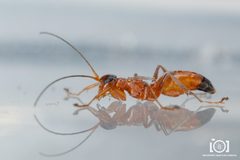
is a small of containing approximately 68 extant in four : Rhopalosoma, Olixon, Liosphex, and Paniscomima. are solitary and often -like in appearance. Larvae are obligate ectoparasitoids of crickets (Orthoptera: ), attaching to the lateral side of the between the metafemur and . The family exhibits remarkable morphological diversity, with winged species typically and brachypterous species mainly . The family has a worldwide tropical and subtropical distribution, absent from Europe and Antarctica.
Pronunciation
How to pronounce Rhopalosomatidae: /rɒpəloʊsoʊˈmætɪdiː/
These audio files are automatically generated. While they are not always 100% accurate, they are a good starting point.
Identification
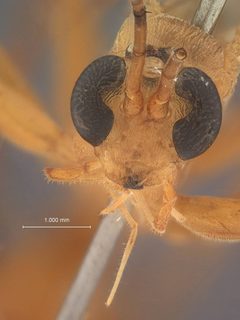
resemble ants and may be confused with them. Key diagnostic features include: tips of two or more antennal segments bearing spines; hindwing (when present) with distinct claval and jugal lobes; and metatibia with a calcar or curved spur. Coloration is typically yellowish with red or brown markings, though some are uniformly brown. Winged species have fully developed wings, while others are brachypterous or wingless with reduced thoracic structures.
Images
Habitat
are poorly documented due to rarity and cryptic . Winged are primarily . Brachypterous and wingless species are mainly and ground-dwelling. In Brazil, Rhopalosoma nearcticum has been collected in park habitats. Olixon species in Australia occur in diverse environments from coastal regions to arid inland areas. Some Neotropical records include caves and tree trunks in Atlantic Forest fragments.
Distribution
Worldwide in tropical and subtropical regions. Absent from Europe and Antarctica. Rhopalosoma: New World, primarily Central and South America, with some in North America. Olixon: Africa, Australia, and the New World from southeastern Canada to central-eastern Argentina; also recorded from India and Madagascar. Paniscomima: India, Madagascar, Africa, and Southeast Asia. Liosphex: southern United States through Central and South America, with one species (L. trichopleurum) in the Philippines and Indonesia.
Diet
diet is unknown. Larvae feed exclusively on crickets (Orthoptera: ), developing as ectoparasitoids on nymphal .
Host Associations
- Gryllidae - primary for larval development
- Trigonidiidae - documented for Rhopalosoma nearcticum and Olixon testaceum
- Phalangopsidae - first Neotropical record from Brazil and Rica
Life Cycle
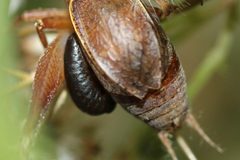
Larvae are ectoparasitoids that attach to the lateral side of nymphs, specifically between the metafemur and , impacting the natural position of the hind leg. This attachment position and larval have remained essentially unchanged for at least 100 million years based on Cretaceous amber fossils. Developmental details of -laying, larval instars, , and are poorly documented.
Behavior
are solitary. Winged are predominantly in activity. Brachypterous and wingless species are mainly . Adults are rarely observed in the field and are considered elusive. Larval involves specialized ectoparasitic attachment to with minimal movement.
Ecological Role
Larvae function as ectoparasitoids regulating . The represents a highly specialized - relationship that has persisted with minimal evolutionary change for approximately 100 million years. Potential role in cricket , though quantitative impact is unknown due to rarity and limited ecological study.
Human Relevance
No known economic importance. Occasionally encountered by entomologists and naturalists. Some recent records have been facilitated by citizen science platforms such as iNaturalist, which have helped document - relationships. The is of scientific interest due to its evolutionary antiquity and morphological diversity.
Similar Taxa
- Formicidae resemble ants in general body form and may be confused with them; distinguished by antennal spines, wing venation, and -like waist structure
- IchneumonidaeWinged resemble ichneumonids; distinguished by antennal segmentation with spines and hindwing lobation
- PompilidaeSome brachypterous resemble spider wasps; distinguished by association and antennal characters
More Details
Fossil Record
The has a significant fossil record with three extinct . Cretolixon and Eorhopalosoma are known from mid-Cretaceous Burmese amber (approximately 100 million years old). Rhopalosoma hispaniola is known from Dominican amber. A fossil larva in Burmese amber demonstrates that the specialized ectoparasitic lifestyle on crickets was already established in the Cretaceous.
Taxonomic History
The was formerly classified with two extinct (Mesorhopalosoma and Paleorhopalosoma) that have been moved to the separate family Angarosphecidae. Current classification recognizes two : Rhopalosomatinae and Olixoninae.
Research Challenges
The remains poorly known biologically due to rarity, cryptic habits, and difficulty in associating larvae with . has recently revealed cryptic and new associations, suggesting that actual species diversity may be substantially higher than currently recognized.
Sources and further reading
- BugGuide
- Wikipedia
- GBIF taxonomy match
- iNaturalist taxon
- NCBI Taxonomy
- Catalogue of Life
- World revision of the wasp genus Liosphex Townes, 1977 (Hymenoptera: Rhopalosomatidae)
- The wasp genus Olixon Cameron in Madagascar: first record and description of two new species (Hymenoptera: Rhopalosomatidae)
- Recent Findings ofOlixon banksiiin the Nearctic with Notes on Its Biology (Hymenoptera: Rhopalosomatidae)
- The wasp larva's last supper: 100 million years of evolutionary stasis in the larval development of rhopalosomatid wasps (Hymenoptera: Rhopalosomatidae)
- A new species of Olixon Cameron, 1887 (Hymenoptera: Rhopalosomatidae) and new records for the genus in Brazil
- Habitat abundances of a cricket-parasitizing wasp <i>Rhopalosoma nearcticum</i> (Hymenoptera: Rhopalosomatidae) in a United States mid-Atlantic park
- Systematics and biogeography of Australian rhopalosomatid wasps (Hymenoptera: Rhopalosomatidae) with a global synopsis of the enigmatic genus Olixon Cameron
- Contributions to the knowledge of Olixon Cameron, 1887 (Hymenoptera, Rhopalosomatidae): a new species and new records of the genus for northeastern Brazil
- New insights into the biology of the rare ectoparasitoid rhopalosomatid wasps (Hymenoptera: Rhopalosomatidae) in the Neotropics: parasitoid–host relationships in Brazil and Costa Rica
- Six in one: cryptic species and a new host record for Olixon Cameron (Rhopalosomatidae, Hymenoptera) revealed by DNA barcoding
- Notes on rhopalosomatid wasps of Dominican and Mexican amber (Hymenoptera: Rhopalosomatidae) with a description of the first fossil species of <i>Rhopalosoma</i> Cresson, 1865
- DNA barcoding of rhopalosomatid larvae reveals a new host record and genetic evidence of a second species of Rhopalosoma Cresson (Hymenoptera, Rhopalosomatidae) in America north of Mexico
- Figure 2 from: Armstrong AL, Sones JE, Lohrmann V, Hebert PDN, Janzen DH, Hallwachs W, Blaschke JD (2024) Six in one: cryptic species and a new host record for Olixon Cameron (Rhopalosomatidae, Hymenoptera) revealed by DNA barcoding. Journal of Hymenoptera Research 97: 363-378. https://doi.org/10.3897/jhr.97.116726
- Figure 6 from: Armstrong AL, Sones JE, Lohrmann V, Hebert PDN, Janzen DH, Hallwachs W, Blaschke JD (2024) Six in one: cryptic species and a new host record for Olixon Cameron (Rhopalosomatidae, Hymenoptera) revealed by DNA barcoding. Journal of Hymenoptera Research 97: 363-378. https://doi.org/10.3897/jhr.97.116726
- Figure 1 from: Miller LA, Benefield TD, Lounsbury SA, Lohrmann V, Blaschke JD (2019) DNA barcoding of rhopalosomatid larvae reveals a new host record and genetic evidence of a second species of Rhopalosoma Cresson (Hymenoptera, Rhopalosomatidae) in America north of Mexico. Journal of Hymenoptera Research 74: 35-46. https://doi.org/10.3897/jhr.74.38276