
Hapithus agitator
Uhler, 1864
Restless Bush Cricket
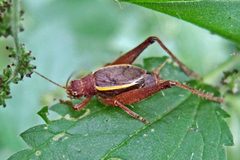
Hapithus agitator, commonly called the restless bush , is a flightless bush cricket in the Oecanthidae. It is notable for its unusual mating system in which males do not produce advertisement calls to attract females; instead, males select mates through chemical interactions during antennal contact. The species is found in North America and has been recorded in the southeastern United States and Cuba.
Pronunciation
How to pronounce Hapithus agitator: //ˈhæpɪθəs ˈædʒɪteɪtɔr//
These audio files are automatically generated. While they are not always 100% accurate, they are a good starting point.
Identification
This can be distinguished from other crickets by its flightless condition and membership in the Hapithus. Males lack the calling songs typical of most species. The silent wing vibration during courtship and the unique chemical-based mate selection system are distinctive behavioral traits. The female's of gnawing at male tegmina to access seminal glands is a notable diagnostic feature of reproductive interactions.
Images
Distribution
Recorded from the southeastern United States (Alabama, Arkansas, Delaware, Florida) and Cuba. The has been documented across 4,568 iNaturalist observations.
Behavior
Males do not produce advertisement calls to attract females, unlike most crickets. Instead, males choose mates based on chemical interactions that occur when individuals connect their . During courtship, males silently vibrate their wings. Females may gnaw at male tegmina (forewings) to reach seminal glands.
Similar Taxa
- Other Hapithus speciesShare flightless condition and general ; distinguished by specific behavioral traits and geographic range
- Calling cricket species (e.g., most Gryllidae)Produce advertisement calls to attract females, whereas H. agitator males are silent and use chemical mate selection
More Details
Taxonomic Note
placement varies between sources: Oecanthidae (iNaturalist, Catalogue of Life) versus Gryllidae (GBIF, NCBI). The Hapithinae is consistently recognized across sources.