
Hapithinae
Gorochov, 1986
Genus Guides
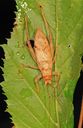
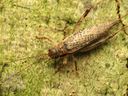
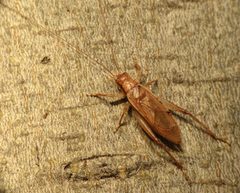
4Hapithinae is a of crickets within the Gryllidae, established by Gorochov in 1986. The group contains small, often colorful crickets, including the well-documented Phyllopalpus. Members are characterized by arboreal habits, occupying foliage and shrubs rather than ground . The subfamily is primarily distributed in the Americas, with some showing northward range expansion in recent decades.
Pronunciation
How to pronounce Hapithinae: //ˈhæpɪθaɪˌniː//
These audio files are automatically generated. While they are not always 100% accurate, they are a good starting point.
Images
Habitat
Arboreal; occupies foliage, shrubs, and low vegetation rather than ground-level .
Distribution
Primarily Americas; documented from southern New England to northern Florida and west to eastern Kansas, Oklahoma, and Texas. Recent observations indicate northward and eastward range expansion into southern Ontario, Quebec, and the Great Lakes region.
Seasonality
activity primarily July through September in temperate regions.
More Details
Taxonomic note
Hapithinae is listed as a in NCBI under Gryllidae, but Catalogue of Life treats it as a supertribe (Hapithinae Gorochov, 1986) within tribe Hapithidi, subfamily Podoscirtinae, Oecanthidae. This discrepancy reflects ongoing classification debates in .
Representative species
Phyllopalpus pulchellus (Red-headed Bush Cricket or Handsome Trig) is the most thoroughly documented member, serving as a reference for understanding characteristics. This exhibits bright red, black, and yellow coloration, modified male forewings for sound production with asymmetrical venation, and a loud, high-pitched trilling call.