
Phanagenia
Banks, 1933
Species Guides
1Phanagenia is a of spider wasps in the tribe Ageniellini, Pompilidae. The genus contains only one in North America, Phanagenia bombycina. These are solitary hunters that construct mud nests to house their offspring, provisioning them with paralyzed spiders.

Pronunciation
How to pronounce Phanagenia: //ˌfænəˈdʒeɪniə//
These audio files are automatically generated. While they are not always 100% accurate, they are a good starting point.
Identification
Distinguished from other Ageniellini by its slightly larger size compared to the related Auplopus. Phanagenia bombycina is found east of the Rocky Mountains, whereas Auplopus has a more widespread distribution.
Images
Appearance
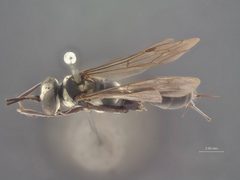
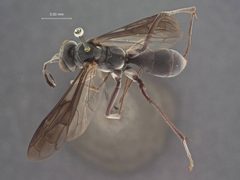
Small, thin, and wiry . range from 5 mm to 15 mm in length. Most are black, including Phanagenia bombycina, with iridescent black wings.
Habitat
Woodlands and woodland edges. rarely visit flowers.
Distribution
North America; Phanagenia bombycina occurs east of the Rocky Mountains.
Diet
Spiders (paralyzed and used as larval provisions).
Life Cycle
Females construct mud barrel nests, often inside the abandoned nests of the pipe organ mud dauber (Trypoxylon politum). Each nest is provisioned with paralyzed spiders and contains a single . The larva feeds on the paralyzed prey, pupates, and emerges as an .
Behavior
Solitary nest-building . Females are not aggressive and will not attack humans even while constructing nests. Nests are often built inside pre-existing mud structures rather than constructed de novo.
Ecological Role
of spiders. May serve as for parasitic (specific not well documented).
Human Relevance
Non-aggressive; poses no sting risk to humans. Nests are sometimes destroyed as perceived nuisances, but is encouraged. Nests can be collected for rearing to study - relationships.
Similar Taxa
- AuplopusAlso in tribe Ageniellini with similar mud-barrel nest construction; Phanagenia is slightly larger and has a more restricted distribution.
- AgeniellaShares tribe Ageniellini and similar nest provisions; distinguished by and geographic range.
- ErageniaRelated in same tribe with similar nesting .
More Details
Nest site selection
Phanagenia bombycina frequently reuses the abandoned mud nests of Trypoxylon politum (pipe organ mud dauber), building its own mud inside these pre-existing structures.