
Dasymutilla foxi
(Cockerell, 1894)
velvet ant
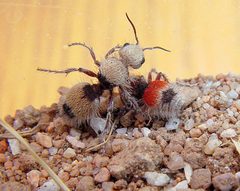
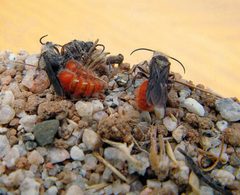
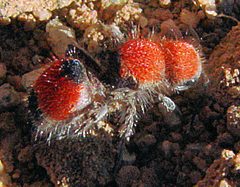
Dasymutilla foxi is a velvet ant in the Mutillidae, found in Mexico and the southwestern United States. The species exhibits highly variable setal coloration, with body segments ranging from whitish to reddish; eastern in Colorado, Kansas, and Texas typically display a black setal patch on the mesosoma. First described by Theodore D. A. Cockerell and named for William J. Fox, this species has been subject to taxonomic revision with Dasymutilla phoenix and Dasymutilla dugesii synonymized under it. Females are wingless and possess a potent sting, while males are winged.
Pronunciation
How to pronounce Dasymutilla foxi: //ˌdæsiˈmjuːtɪlə ˈfɒksaɪ//
These audio files are automatically generated. While they are not always 100% accurate, they are a good starting point.
Identification
Distinguished from other Dasymutilla by its highly variable setal coloration, with individual body segments ranging from whitish to reddish. Eastern (Colorado, Kansas, Texas) are identifiable by a characteristic black setal patch on the mesosoma. Females are wingless and -like in appearance; males possess wings. Size ranges from 5 to 11 mm based on Mickel's 1928 observations.
Images
Distribution
Mexico and the southwestern United States. Documented in Colorado, Kansas, Texas, and Oklahoma (with county-wide distribution records in Oklahoma per 2013 study).
Host Associations
- Diadasia species - parasitizesfemales parasitic in nests of Diadasia per Cockerell specimens
Behavior
New behavioral observations have been documented for this in Oklahoma, though specific details require access to the full 2013 study. Females are known to actively search for nests. Both sexes can produce audible stridulation by rubbing abdominal segments together, a trait common in the .
Ecological Role
of ground-nesting bees; specifically documented as parasitizing nests of Diadasia . As a member of the Mutillidae, contributes to of solitary .
Human Relevance
Females possess a potent sting and should not be handled. The name honors entomologist William J. Fox.
Similar Taxa
- Dasymutilla bioculataSimilar size range and geographic overlap; D. foxi distinguished by variable setal coloration pattern and black mesosomal patch in eastern versus D. bioculata's more consistent coloration
- Dasymutilla occidentalisBoth are red-and-black velvet ants with painful stings; D. foxi lacks the consistent bright red coloration of D. occidentalis and shows greater setal variability
Sources and further reading
- BugGuide
- Wikipedia
- GBIF taxonomy match
- iNaturalist taxon
- NCBI Taxonomy
- Bembicid Holdings | Entomology Research Museum
- Insect FAQs | Entomology Research Museum
- Bug Eric: Wasp Wednesday: Dasymutilla bioculata
- The gloriously dichromatic Dasymutilla gloriosa | Beetles In The Bush
- A sting to kill a cow? Red velvet ant, a.k.a. cow killer, Dasymutilla occidentalis — Bug of the Week
- Museum Collections and Notes Lead to the Rediscovery of a Grasshopper Not Seen in 60 Years
- Velvet Ants, Past and Present: A County-Wide Checklist of the Distribution and Diversity of Mutillidae (Insecta: Hymenoptera) in Oklahoma Including Two New State Records, and New Behavioral Observations for Dasymutilla foxi (Cockerell)