
Diadasia
Patton, 1879
cactus bees, bindweed turret bees
Species Guides
8- Diadasia australis(Cactus chimney bees)
- Diadasia bituberculata(Bindweed Turret Bee)
- Diadasia diminuta(globe mallow bee)
- Diadasia enavata(Sunflower Chimney Bee)
- Diadasia laticauda
- Diadasia nigrifrons(Black-fronted turret bee)
- Diadasia ochracea(Ochraceous Chimney Bee)
- Diadasia rinconis(Cactus Bee)
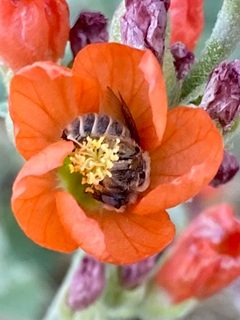
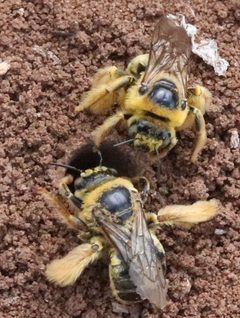
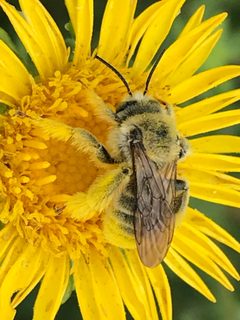
Diadasia is a of solitary bees in the Apidae, tribe Emphorini, containing approximately 42 . These bees are oligolectic pollen that primarily forage on plants in the family Malvaceae, though some species have evolved associations with other plant groups including cacti, bindweeds, and willowherbs. They are ground-nesting bees, with many species constructing distinctive turrets or chimney-like structures at their nest entrances. Male Diadasia form large mating where they compete intensely for access to emerging females.
Pronunciation
How to pronounce Diadasia: //daɪəˈdeɪziə//
These audio files are automatically generated. While they are not always 100% accurate, they are a good starting point.
Identification
Diadasia are distinguished from other Emphorini by their oligolectic specialization on Malvaceae and related plant . Species-level identification requires examination of morphological characters including male genitalia and subtle differences in coloration and body proportions. D. rinconis, the 'cactus ,' is recognizable by its association with Sonoran Desert cacti. D. bituberculata, the bindweed turret bee, is identified by its distinctive turreted nests and specialization on morning glory flowers.
Images
Habitat
Diadasia occupy diverse across western North America, from desert environments to montane regions. They require suitable soil substrates for ground nesting, with preferences varying by species—some favor sandy soils, others clayey or loamy textures. The bindweed turret (D. bituberculata) nests in areas with morning glory plants, including open spaces and trail edges. D. rinconis is closely tied to Sonoran Desert cactus . Agricultural landscapes with appropriate soil conditions and host plant availability can support nesting .
Distribution
Western North America, with highest diversity in the southwestern United States and adjacent Mexico. Documented from California (including coastal and montane regions), Arizona, New Mexico, Colorado, Utah, Oregon, and the Sonoran Desert. D. bituberculata is native to California. D. diminuta occurs in northwestern California and southwestern Oregon. The extends southward into Mexico.
Seasonality
activity varies by and local climate. D. bituberculata is active from late spring through early summer, coinciding with morning glory flowering. D. rinconis activity is tied to cactus flowering in the Sonoran Desert, typically peaking in May. Most species are with a single per year.
Diet
Oligolectic pollen . The -level ancestral association is with Malvaceae (mallows). Derived switches include: asters (Asteraceae), bindweeds (Convolvulaceae), cacti (Cactaceae), and willowherbs (Onagraceae). D. rinconis feeds almost exclusively on Sonoran Desert cactus . D. bituberculata specializes on bindweed/morning glory (Convolvulaceae). D. diminuta primarily uses Malvaceae but has been observed switching to the rare mallow Iliamna latibracteata when typical hosts are unavailable. Nectar is collected from host flowers.
Host Associations
- Malvaceae - pollen ancestral and most common for the
- Convolvulaceae - pollen specialized for D. bituberculata and related
- Cactaceae - pollen specialized for D. rinconis in Sonoran Desert
- Asteraceae - pollen for some derived
- Onagraceae - pollen willowherbs as for some
- Iliamna latibracteata - alternative pollen rare mallow used by D. diminuta when typical unavailable
Life Cycle
Solitary bees with ground-nesting . Females excavate burrows in soil, often constructing turrets or chimneys at the entrance. are provisioned with pollen collected from plants, forming a pollen-nectar mass upon which an is laid. Larvae develop within the cell, consuming the provision. occurs in the nest, with emerging the following season. Most are . Developmental timing is synchronized with host plant flowering.
Behavior
Males form large at nest sites where females emerge, engaging in and forming 'mating balls' around receptive females. In D. rinconis, hundreds to thousands of males may patrol nesting areas simultaneously. Males exhibit size-based competitive advantages, with larger males achieving higher mating success though spending less time per mating. Females are solitary nest builders, each constructing and provisioning her own burrow without cooperative . Some nest in dense aggregations, creating the appearance of social colonies.
Ecological Role
Important of their plants, with tight evolutionary relationships driving reciprocal specialization. The oligolectic foraging strategy ensures efficient pollen transfer within host plant lineages. As ground-nesting bees, they contribute to soil bioturbation. They serve as hosts for multiple lineages including bee flies (Bombyliidae), velvet ants (Mutillidae), ripiphorid beetles (Ripiphoridae), and blister beetles (Meloidae), supporting diverse parasitoid .
Human Relevance
Potential for managed pollination in agricultural systems requiring Malvaceae or cactus pollination, though not currently commercially reared. Research interest in understanding , mating systems, and responses to agricultural practices. D. bituberculata has been featured in public science communication (KQED Deep Look documentary). Ground-nesting requirements make vulnerable to soil disturbance from tillage and application. Research by Rei Scampavia on ground-nesting bee biology has highlighted the as a model for understanding agricultural impacts on native bees.
Similar Taxa
- MelissodesAlso tribe Emphorini with similar body form and ground-nesting , but Melissodes are generally polylectic and lack the pronounced turret-building behavior of some Diadasia
- AnthophoraGround-nesting Apidae with similar size and appearance, but Anthophora are typically polylectic and nest in different soil textures without turret construction
- SvastraRelated emphorine bees with similar , but with different plant associations and nesting
More Details
Mating system research
High-speed videography of D. rinconis has revealed complex courtship including raising, wing flicking, leg stroking, and rocking movements accompanied by pulsing sounds. Research by Avery Russell and colleagues documented size-dependent mating success and trade-offs between mating frequency and duration.
Nest architecture
The turrets constructed by D. bituberculata and related are among the most elaborate nest structures in ground-nesting bees, potentially functioning in defense, microclimate regulation, or mate location.
Agricultural sensitivity
Research indicates that tillage and irrigation can positively influence nest site selection, but residues may create ecological traps where bees are attracted to suboptimal nesting with reduced offspring survival.
Sources and further reading
- BugGuide
- Wikipedia
- GBIF taxonomy match
- iNaturalist taxon
- NCBI Taxonomy
- Catalogue of Life
- The Glory of the Bindweed Turret Bees | Bug Squad
- Congratulations, Rei! | Bug Squad
- UC Davis: All A'Buzz With Bee Nests and Art | Bug Squad
- Busy Bees: An Up-Close Look at One Bee Species' Scramble to Mate
- Bug Eric: World Bee Day....A Little "Bee"hind
- Bug Eric: A Beautiful Place to "Bee"
- Pollen-host specificity and evolutionary patterns of host switching in a clade of specialist bees (Apoidea: Diadasia)
- Host-switching by a bee where its usual pollen host is not present: Diadasia diminuta (Cresson, 1878) (Apidae: Eucerinae: Emphorini) uses the rare mallow, Iliamna latibracteata Wiggins (Malvaceae), as its pollen host in northwestern California and southwestern Oregon