
Dasymutilla arenerronea
Bradley, 1916
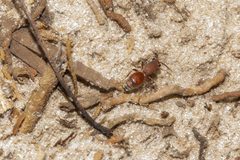
Dasymutilla arenerronea is a of velvet ant in the Mutillidae, described by Bradley in 1916. Like all mutillids, it is actually a rather than an , with wingless females and winged males. The species belongs to a large of solitary wasps that primarily target ground-nesting bees and wasps. Females are capable of delivering a painful sting, a trait common across the family.
Pronunciation
How to pronounce Dasymutilla arenerronea: //ˌdeɪ.siˈmjuː.tɪ.lə ˌaɪə.nəˈroʊ.ni.ə//
These audio files are automatically generated. While they are not always 100% accurate, they are a good starting point.
Identification
No specific diagnostic features are documented to distinguish D. arenerronea from . Identification to level in Dasymutilla requires expert examination, often involving genitalia dissection in males and detailed setal pattern analysis in females. The species was synonymized under broader concepts in some treatments but is currently recognized as valid.
Images
Appearance
Specific morphological details for D. arenerronea are not documented in available sources. As a member of Dasymutilla, females are wingless and densely hairy, giving the characteristic 'velvet' appearance. Males possess wings. Most Dasymutilla exhibit aposematic coloration, typically combinations of red, orange, or white with black.
Habitat
Specific preferences are not documented. Related Dasymutilla occur in arid and semi-arid environments including deserts, prairies, and sandy areas where nests are accessible.
Distribution
Documented from the southwestern United States. The specific epithet 'arenerronea' (from Latin arena = sand, erronea = wandering) suggests association with sandy .
Seasonality
activity periods are not documented for this .
Host Associations
- Ground-nesting bees and wasps - Specific unknown; Dasymutilla generally parasitize nests of solitary and bees, especially crabronid and sphecid wasps
Life Cycle
Not documented for this . Related species have solitary : females locate nests, lay in , and larvae consume host pupae or larvae.
Behavior
Not documented for this . Female Dasymutilla are known for rapid, erratic running while searching for nests. Both sexes can produce audible stridulation by rubbing abdominal segments together.
Ecological Role
As a , contributes to regulation of ground-nesting hymenopteran . Females participate in Müllerian mimicry complexes with other aposematic .
Human Relevance
Females can deliver a painful sting if mishandled, though no specific reports exist for this . Not known to be economically significant.
Similar Taxa
- Dasymutilla occidentalisSimilar size range and coloration pattern; distinguished by specific setal patterns and geographic distribution
- Dasymutilla bioculataFormerly included multiple now synonymized; D. arenerronea may have been confused with this broadly defined prior to 2010 revision
More Details
Taxonomic History
The was described by Bradley in 1916. A major 2010 molecular revision by Williams et al. synonymized many Dasymutilla species, but D. arenerronea was not among those lumped into D. bioculata, suggesting it represents a distinct lineage.
Etymology
The specific epithet combines Latin 'arena' (sand) and 'erronea' (wandering/erroneous), possibly alluding to its sandy and perhaps initial taxonomic confusion.
Sources and further reading
- BugGuide
- GBIF taxonomy match
- iNaturalist taxon
- Insect FAQs | Entomology Research Museum
- Bug Eric: Wasp Wednesday: Dasymutilla bioculata
- The gloriously dichromatic Dasymutilla gloriosa | Beetles In The Bush
- A sting to kill a cow? Red velvet ant, a.k.a. cow killer, Dasymutilla occidentalis — Bug of the Week
- Mutillidae | Beetles In The Bush
- Bees vs wasps: what's the difference? - Buglife Blog - Buglife