
Hesperapis
Cockerell, 1898
Species Guides
5- Hesperapis fuchsi(Fuch's Evening Bee)
- Hesperapis larreae(Creosote Evening Bee)
- Hesperapis oraria(Gulf Coast solitary bee)
- Hesperapis regularis(Clarkia Evening Bee)
- Hesperapis rufipes(Woollystar Evening Bee)
Hesperapis is a of ground-nesting bees in the Melittidae, containing at least 30 described . These solitary bees are characterized by a flattened and soft compared to other groups. The genus is considered uncommon and includes species with specialized floral associations, including monolectic pollen specialization on single plant species. Some species exhibit prolonged lasting multiple years.
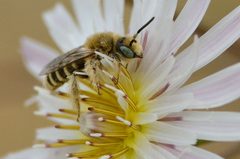
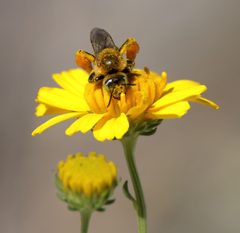
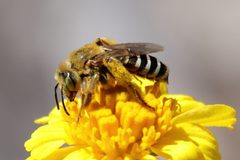
Pronunciation
How to pronounce Hesperapis: //ˌhɛspəˈreɪpɪs//
These audio files are automatically generated. While they are not always 100% accurate, they are a good starting point.
Identification
Distinguished from other by the combination of a distinctly flattened and unusually soft . Within Melittidae, placement in Hesperapini separates it from other tribes. -level identification requires examination of morphological details not specified in available sources.
Images
Appearance
Flattened ; soft () relative to other groups
Habitat
Coastal and inland sandy ; ground-nesting in sandy soils. -specific requirements vary: Hesperapis oraria is restricted to northern Gulf of Mexico coastal habitats with proximity to ephemeral wetlands, while other species occupy sandy substrates in different regions.
Distribution
occur in North America; Hesperapis oraria is to the northern Gulf of Mexico coast (coastal mainland and barrier islands). Full geographic range of not detailed in available sources.
Seasonality
Activity patterns vary by ; Hesperapis rhodocerata has been observed exhibiting prolonged with in some years but not consecutive years.
Diet
forage on flowers for pollen and nectar. Larval diet consists of pollen-nectar provisions supplied by females. Some are monolectic pollen : Hesperapis oraria exclusively collects pollen from Balduina angustifolia (Asteraceae).
Host Associations
- Balduina angustifolia - pollen exclusive pollen source for Hesperapis oraria
Life Cycle
Complete with distinct and larval instars. Females construct individual ground nests and provision with pollen-nectar masses. Larvae progress through multiple instars before . may be prolonged over multiple years in some .
Behavior
Solitary ground-nesting; females construct and provision individual nests. Foraging varies by , with some exhibiting strict floral specialization. Nesting occurs in sandy substrates.
Ecological Role
; pollen contribute to of specific plants.
Human Relevance
Hesperapis oraria is considered an at-risk due to specialization and restricted range. Conservation concern exists for coastal habitat-dependent species.
Similar Taxa
- Other Melittidae generaShare -level traits but differ in abdominal flattening and texture; Hesperapis has diagnostic soft, flattened body form
- Hesperapis larreaeCompared with H. rhodocerata in biological studies; differs in foraging and floral specialization despite similar larval development
More Details
Taxonomic rarity
The is described as 'very uncommon' in occurrence, reflecting both actual rarity and possibly cryptic habits in sandy .
Species diversity
At least 30 described , with some sources indicating 37 species; taxonomic inventory may be incomplete due to rarity and specialized .
Sources and further reading
- BugGuide
- Wikipedia
- GBIF taxonomy match
- iNaturalist taxon
- NCBI Taxonomy
- Catalogue of Life
- Hesperapis rhodocerata: Behavioral Biology, Egg, and Larval Instars, Including Behavioral and Larval Comparisons withH. larreae(Hymenoptera: Melittidae: Dasypodainae)
- Habitat suitability of an at-risk, monolectic, ground-nesting bee Hesperapis oraria and its floral host Balduina angustifolia at two spatial scales along the Northern Gulf of Mexico
- Supplemental Material for American Museum novitates, no. 3856 : Portion of unpublished, undated ms. by Gerald I. Stage (numbered pp. 14�96 and pp. 406�410), on the biology of the bee genus Hesperapis