
Hesperapis oraria
Snelling & Stage, 1997
Gulf Coast solitary bee, Gulf Coast evening bee
Hesperapis oraria is a rare, solitary to the northern Gulf Coast of the United States. Described in 1997, it is the only known member of the Dasypodainae in eastern North America. The is monolectic, relying exclusively on the coastal plain honeycomb (Balduina angustifolia) for pollen and nectar. It is critically imperiled due to its restricted range and specificity.
Pronunciation
How to pronounce Hesperapis oraria: //ˌhɛspəˈreɪpɪs oʊˈreɪriə//
These audio files are automatically generated. While they are not always 100% accurate, they are a good starting point.
Identification
The only Dasypodainae in eastern North America; all other Hesperapis occur in western North America or South Africa. Distinguished from other Gulf Coast bees by monolectic association with Balduina angustifolia, September–October period, and ground-nesting in coastal dunes. Male pygidial plate shape and female hind leg setae structure provide diagnostic characters.
Images
Appearance
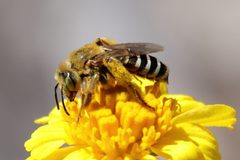
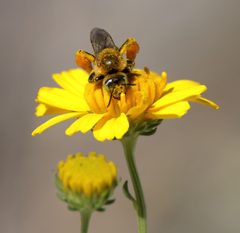
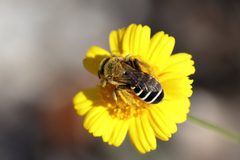
Females 11–13 mm, males 8.5–11 mm. Shiny black with dense hairs. Yellowish, mesosoma. Clear to brownish wings. Dark brown to reddish legs with dense hair. Metasoma with alternating dark and light bands. Females have modified hind basitarsi setae forming a trough-like depression for nest excavation. Males distinguished by subtriangular pygidial plate ending in a point; female pygidial plates broad with points greater than 45°.
Habitat
Secondary dunes behind foredunes on barrier islands and coastal mainland within 500 m of shoreline. Requires dense patches of Balduina angustifolia (minimum 12 patches per site, minimum 111.5 m² patch area) and fine, crumbly sandy soil for nesting. Found between 110–475 m from Gulf coastline. Absent from non-coastal mainland sites regardless of plant presence. maintained by intermediate disturbance from wind, water, storms, and low-intensity fire.
Distribution
to northern Gulf Coast of United States: Florida, Alabama, and Mississippi. Historic range approximately 320 km linear distance from Horn Island, Mississippi to St. Andrew's Bay, Florida. Not recorded in Mississippi or Alabama since 1994. Extirpated or likely extirpated from Choctawhatchee Bay and Pensacola Bay areas.
Seasonality
activity September–October, coinciding with bloom of Balduina angustifolia. with one per year.
Diet
Monolectic pollen on Balduina angustifolia (Asteraceae). consume nectar and collect pollen exclusively from this .
Host Associations
- Balduina angustifolia - obligate pollen sole pollen and nectar source; monolectic relationship
Life Cycle
Females construct underground nests in soft sand, provisioning with pollen balls upon which single are laid. Larvae develop through approximately five instars, entering as pre-pupa/post-defecating larvae. occurs after diapause, with timed to plant bloom. Extended diapause of two to three years has been observed in and may occur in this .
Behavior
Females excavate burrows using modified hind leg setae; nests potentially aggregated with multiple burrows per square meter. Males patrol and sleep on plant flowers, attempting matings at flowers (observed unsuccessfully) or at nest sites. Males rest on flowers during severe weather. Activity on flowers contributes to pollination efficacy.
Ecological Role
Obligate of Balduina angustifolia; likely the primary or sole pollinator of this plant . Contributes to dune dynamics through pollination services and soil disturbance from nesting.
Human Relevance
Critically imperiled (G1, NatureServe 2007; S1/S2 Florida). Petitioned for federal Act protection in 2019. Vulnerable to loss from coastal development, hurricane damage, and fire suppression reducing habitat connectivity. No formal state or federal protection currently in effect.
Similar Taxa
- Other Hesperapis species39 in western North America and South Africa; distinguished by geographic distribution and male genitalic characters
- Other Gulf Coast beesNone share the combination of Dasypodainae , monolectic association with Balduina angustifolia, and September–October period