
Hesperapis larreae
Cockerell, 1907
Creosote Evening Bee
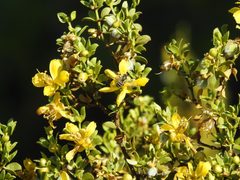
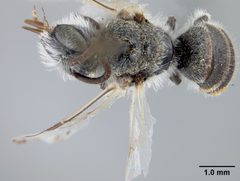
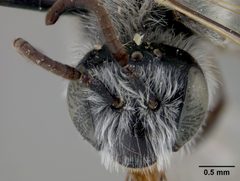
Hesperapis larreae is a solitary, ground-nesting in the Melittidae, Dasypodainae. It is commonly known as the Creosote Evening Bee, suggesting a close association with creosote bush (Larrea tridentata). The was described by Cockerell in 1907 and occurs in arid regions of North America and Middle America. As a member of the small bee family Melittidae, it represents one of the more basal lineages within the .
Pronunciation
How to pronounce Hesperapis larreae: //ˌhɛs.pəˈræ.pɪs ˌlær.iˈi//
These audio files are automatically generated. While they are not always 100% accurate, they are a good starting point.
Images
Habitat
Ground-nesting; inferred association with creosote bush (Larrea tridentata) based on and specific epithet.
Distribution
North America; Middle America.
Host Associations
- Larrea tridentata - inferred pollen/nectar sourceInferred from 'Creosote Evening ' and specific epithet 'larreae'; not confirmed in provided sources.
Behavior
Solitary nesting ; nests in the ground.
Similar Taxa
- Hesperapis rhodocerataCongeneric in the same Dasypodainae; subject of comparative behavioral and larval study with H. larreae.
More Details
Taxonomic placement
Hesperapis larreae belongs to the Melittidae, a small family of bees representing one of the basal lineages of . The Dasypodainae and tribe Hesperapini indicate its position within this relictual group.