
Hesperapis regularis
(Cresson, 1878)
Clarkia Evening Bee
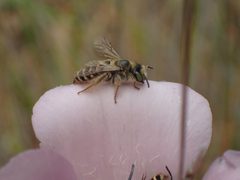
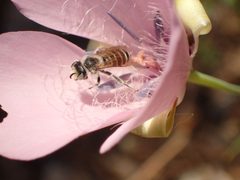
Hesperapis regularis is an oligolectic to California, specialized in collecting pollen exclusively from flowers of the Clarkia. Unlike most bees, it is active in the evening hours. Females construct underground nests where they provision chambers with a mixture of Clarkia pollen and nectar for larval development.
Pronunciation
How to pronounce Hesperapis regularis: /hɛˈspɛr.ə.pɪs rɛˈɡjuː.lɛr.ɪs/
These audio files are automatically generated. While they are not always 100% accurate, they are a good starting point.
Identification
Distinguished from other Hesperapis by its strict association with Clarkia flowers. The evening foraging activity is unusual among bees and may aid identification. Specific morphological diagnostic features are not documented in available sources.
Images
Habitat
Found in meadows, fields, and gardens across California chaparral and woodlands, montane, and valley . Occurs wherever its plant Clarkia grows.
Distribution
to California, United States.
Diet
consume nectar. Larvae feed on a provisioned mass of Clarkia pollen mixed with nectar stored in underground chambers.
Host Associations
- Clarkia - pollen/nectar sourceStrictly oligolectic; visits only Clarkia flowers for pollen collection
Life Cycle
Females construct underground nests with chambers provisioned with pollen-nectar masses. Larvae develop on these provisions within the nest chambers.
Behavior
Exhibits evening foraging activity, an uncommon trait among bees. Females actively collect pollen and nectar from Clarkia flowers during this period.
Ecological Role
Specialized of Clarkia . Its oligolectic suggests tight coevolutionary relationship with this plant .
Similar Taxa
- Other Hesperapis speciesOther in lack strict specialization on Clarkia and may show different activity periods
- Generalist beesMost bees collect pollen from multiple plant rather than a single
More Details
Oligolecty
This represents a classic example of oligolecty—specialized pollen collection from a narrow range of plants. In this case, the specialization is extreme, involving only the Clarkia.
Temporal niche
Evening foraging is rare among bees and may reduce competition with other while exploiting Clarkia flowers during their peak availability period.