
Megachile policaris
Say, 1831
Texas leafcutter bee, policaris leafcutter bee
Megachile policaris is a large, solitary leafcutter bee native to North America that has established in Hawaiʻi. First detected on Oʻahu in 2017, it is now present on multiple Hawaiian islands including Maui, Kauaʻi, and Hawaiʻi Island. It is among the largest Megachile in North America, with females reaching 18–22 mm. The species constructs nests in pre-existing cavities and uses cut leaf pieces to line .
Pronunciation
How to pronounce Megachile policaris: //ˌmɛɡəˈkaɪli pəˈlɪkərɪs//
These audio files are automatically generated. While they are not always 100% accurate, they are a good starting point.
Identification
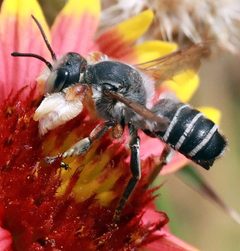
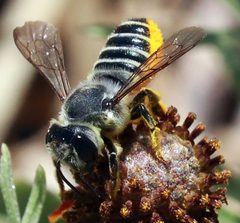
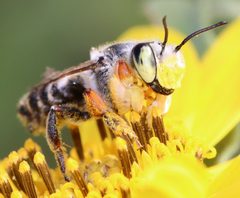
Large body size distinguishes M. policaris from most : females measure 18–22 mm, among the largest Megachile in North America. The is robust and non-metallic black. Females carry pollen on scopal hairs beneath the rather than on leg baskets. Dentate are large in females, used for cutting leaf sections. Males have spinose front and enlarged front . The is nearly perpendicular to the propodeum rear, with a broad scutellum and roughly straight margin. and lack carinae; notaulices are linear.
Images
Habitat
In its native range, nests in pre-existing cavities including hollow stems, twigs, rotting wood, and soil burrows. In Hawaiʻi, established in both urban and natural areas across multiple islands, including windward and leeward . Ensemble distribution models predict high suitability for leeward lowlands and high elevations, though observations on windward Hawaiʻi Island indicate broader climatic .
Distribution
Native to North America (United States and Mexico). Introduced to Hawaiʻi: first detected on Oʻahu in 2017, subsequently documented on Maui, Kauaʻi, and Hawaiʻi Island with established persisting from 2017 to 2020.
Diet
forager collecting pollen and nectar. In native range, documented visiting at least 21 plant ; plant families present in Hawaiʻi include representatives of these groups.
Life Cycle
Solitary with no social structure. Females construct individual nests in pre-existing cavities, cutting oval or circular leaf sections to line . Each cell receives a provision of pollen and nectar ("bee loaf") with a single deposited on top. Larvae feed on stored provisions, overwinter, and emerge the following spring by gnawing through nest walls. Alternatively, females may use dried plant resin carried in to line cells.
Behavior
Females cut leaf pieces from living plants to construct nest linings, sometimes creating visible damage to garden plants including roses. They transport leaf sections held in back to nest cavities. The has a weak sting used defensively. Does not produce honey.
Ecological Role
Human Relevance
Valued as a in native range. status in Hawaiʻi raises conservation concerns for native fauna. Leaf-cutting can damage ornamental plants, particularly roses.
Similar Taxa
- Megachile sculpturalisBoth are large, non-native Megachile ; M. sculpturalis uses resin rather than leaves to line nests and is native to Asia rather than North America
- Other Megachile speciesM. policaris is distinguished by exceptional size (18–22 mm females), larger than most which are typically 10–15 mm
- Apis melliferaBoth are , but honey bees are social, have corbiculae () on hind legs, and are smaller with different body proportions
Sources and further reading
- BugGuide
- Wikipedia
- GBIF taxonomy match
- iNaturalist taxon
- NCBI Taxonomy
- Catalogue of Life
- Looking for Cheap Urban Real Estate | Bug Squad
- In Search of the World's Biggest Bee: How It Came to 'Bee' | Bug Squad
- Photographer Allan Jones Exudes Patience, Skill and Talent | Bug Squad
- The Most Incredible Image of a Leafcutter Bee | Bug Squad
- The Native Bees in the UC Davis Bee Haven | Bug Squad
- Mailbox posts are fine homes for giant resin bees, Megachile sculpturalis — Bug of the Week
- The Invasion ofMegachile policaris(Hymenoptera: Megachilidae) to Hawai‘i