
Coelioxys rufitarsis
Smith, 1854
red-legged cuckoo leafcutter bee, red-footed cuckoo leafcutter
Coelioxys rufitarsis is a cleptoparasitic in the Megachilidae, commonly known as the red-legged cuckoo leafcutter bee. Native to North America, this does not construct its own nests but instead parasitizes the nests of other megachilid bees, particularly leafcutter bees in the Megachile. Females deposit in nest , and their larvae kill the host egg or larva before consuming the pollen provisions intended for the host offspring.
Pronunciation
How to pronounce Coelioxys rufitarsis: /ˌsɛl.iˈɒk.sɪs ˌruː.fɪˈtɑːr.sɪs/
These audio files are automatically generated. While they are not always 100% accurate, they are a good starting point.
Identification
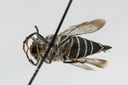
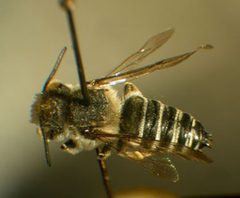
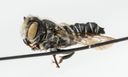
Members of Coelioxys are distinguished from their Megachile by a sharply pointed with a prominent pygidial plate, adapted for piercing host nest partitions. The specific epithet rufitarsis refers to reddish coloration on the (leg segments). Females have a conical, pointed abdomen, while males possess modified abdominal sterna. Coelioxys generally lack the dense scopal hairs on the abdomen that Megachile females use for pollen transport.
Images
Habitat
Distribution
Native to North America. Documented from the United States including Vermont, with records across the continent.
Diet
feed on nectar from flowers. Larvae consume pollen and nectar provisions originally collected by female bees for their own offspring.
Host Associations
- Megachile latimanus - Known
- Megachile melanophoea - Known
- Megachile perihirta - Known
Life Cycle
Behavior
Females are known to hover near nest entrances, waiting for opportunities to enter and oviposit when host females are absent. Males are often observed patrolling flowers or nest seeking mates.
Ecological Role
Acts as a regulator of leafcutter bee populations. As a , it represents a natural source of mortality for within native .
Human Relevance
Occasionally encountered by beekeepers and observers of native hotels. Its presence indicates healthy of Megachile . Not directly beneficial or harmful to agriculture, but contributes to native bee dynamics.
Similar Taxa
- Megachile spp. ; distinguished by rounded with scopa for pollen carrying in females, and lack of pointed pygidial plate
- Other Coelioxys speciesSimilar cleptoparasitic lifestyle and pointed ; identification to level requires examination of specific morphological characters including tarsal coloration and genitalia
More Details
Nesting biology
Unlike most Megachilidae, Coelioxys do not cut leaves or construct nests. The cuckoo leafcutter bee refers to their parasitic relationship with leafcutter bees, not their own .
Taxonomic note
The specific epithet rufitarsis (red-footed/) provides a diagnostic character distinguishing this from , though precise identification requires expert examination.