
Megachile perihirta
Cockerell, 1898
Western Leafcutter Bee, Western leafcutting bee
Megachile perihirta, commonly known as the Western Leafcutter Bee, is a solitary native to western North America. It is an important of alfalfa and other crops, recognized by its distinctive leaf-cutting where females cut circular pieces from leaves to line nest . The nests in pre-existing cavities in soil, sand, gravel, or rotting wood, and carries pollen on a scopa located on the underside of the rather than on the hind legs.
Pronunciation
How to pronounce Megachile perihirta: /ˌmɛɡəˈkaɪli pɛˈraɪhɪrtə/
These audio files are automatically generated. While they are not always 100% accurate, they are a good starting point.
Identification
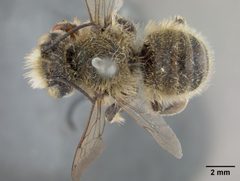
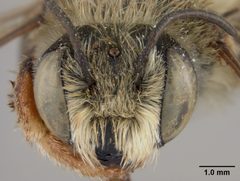
Distinguished from other Megachile by the combination of black body with long whitish-yellow hair below and , mostly bare abdomen with scattered whitish segmental hair, and bright red scopa. Differs from honey bees and bumble bees by carrying pollen on abdominal scopa rather than corbiculae on hind legs. Separable from other western North American Megachile by hair and distribution patterns; M. perihirta has more extensive pale hair than many .
Images
Appearance
Black body with long whitish-yellow hair, denser below the and . Abdomen is mostly bare with scattered whitish hair on each segment. Wings are clear with black . (scopa) on the underside of the abdomen is bright red when loaded with pollen. present: females have scopa for pollen collection, males lack scopa and often have more extensive pale markings.
Habitat
Meadows, orchards, and agricultural fields, particularly alfalfa seed production areas. Nests in pre-existing cavities in sand, gravel, soil, or rotting wood and plant material. Requires bare ground or suitable cavities for nesting, and diverse flowering plants for foraging.
Distribution
Western North America, ranging from Nebraska to Texas and Mexico, westward to California, and north to British Columbia and Alberta.
Seasonality
active primarily from July to August. One per year with adults living approximately one year.
Diet
feed on nectar. Larvae feed on provisions of pollen and nectar deposited in nest . Strongly associated with alfalfa (Medicago sativa) in agricultural settings; also forages on other flowering plants.
Life Cycle
Solitary. Females excavate or occupy pre-existing burrows in soil, sand, gravel, or rotting plant material. Constructs series of lined with circular leaf fragments cut from plants. Each cell provisioned with pollen-nectar mixture and receives one . Larva develops within cell, consuming provisions. Pupates within cell. emerge following year.
Behavior
Exhibits leaf-cutting : females cut circular or oval pieces from leaves using , then transport these fragments to nest for lining. Carries pollen on scopa rather than leg baskets. Solitary nesting, though small groups may aggregate nesting sites. Effective buzz of alfalfa flowers, tripping keel mechanism to access pollen.
Ecological Role
Principal of alfalfa for commercial seed production in western North America. Contributes to pollination of other flowering plants in meadow and orchard . As a native , supports plant reproductive success and maintains floral structure.
Human Relevance
Managed and encouraged in alfalfa seed production for its superior pollination compared to honey bees. Nest blocks and condos provided in agricultural and garden settings to support . Leaf-cutting activity occasionally considered minor nuisance to ornamental plants, though generally tolerated due to pollination benefits.
Similar Taxa
- Megachile dentitarsusCo-occurring ground-nesting Megachile in southern Alberta, also important alfalfa ; distinguished by differences in mandibular and tarsal
- Megachile rotundata (Alfalfa Leafcutter Bee)Commercially managed alfalfa with similar ; M. perihirta has more extensive pale hair and different western distribution
- Apis mellifera (Honey Bee)Sympatric managed ; differs in social colony structure, corbiculate pollen transport on hind legs, and lack of leaf-cutting
More Details
Pollen Collection
Unlike honey bees and bumble bees, Megachile perihirta carries pollen in a scopa—a dense brush of hairs on the surface of the —rather than in corbiculae () on the hind legs. This trait is diagnostic for the Megachile and Megachilinae.
Agricultural Significance
Research in southern Alberta identified M. perihirta and M. dentitarsus as the principal native of alfalfa, outperforming other Megachile in frequency, abundance, and pollination effectiveness in mixed prairie environments.
Sources and further reading
- BugGuide
- Wikipedia
- GBIF taxonomy match
- iNaturalist taxon
- NCBI Taxonomy
- Catalogue of Life
- Looking for Cheap Urban Real Estate | Bug Squad
- In Search of the World's Biggest Bee: How It Came to 'Bee' | Bug Squad
- Photographer Allan Jones Exudes Patience, Skill and Talent | Bug Squad
- The Most Incredible Image of a Leafcutter Bee | Bug Squad
- The Native Bees in the UC Davis Bee Haven | Bug Squad
- A Big Bee Bash Is Beckoning: Learn About California's Native Bees | Bug Squad
- Ecology of the Leaf-cutter Bee Megachile perihirta Ckll. (Hymenoptera: Megachilidae) in Relation to Production of Alfalfa Seed