
Lithurgopsis gibbosa
(Smith, 1853)
Southeastern Woodborer, Gibbous Woodborer Bee
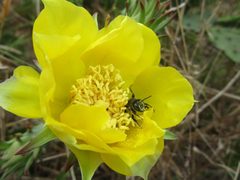
Lithurgopsis gibbosa is a large, robust solitary in the Megachilidae, commonly known as the Southeastern Woodborer or Gibbous Woodborer Bee. It is one of the largest native bees in eastern North America and is notable for its distinctive humped and wood-boring nesting . The occurs primarily in the southeastern United States, where females excavate nest tunnels in dead wood and provision with pollen and nectar.
Pronunciation
How to pronounce Lithurgopsis gibbosa: /lɪˌθɜrˈɡɒpsɪs dʒɪˈboʊsə/
These audio files are automatically generated. While they are not always 100% accurate, they are a good starting point.
Identification
Lithurgopsis gibbosa can be distinguished from other Lithurgopsis by its large size (among the largest native bees in eastern North America), robust and somewhat humped (gibbous) , and overall dark coloration with pale hair bands. The Lithurgopsis is separated from the related genus Lithurgus by distribution (New World vs. Old World) and subtle morphological differences. Females carry pollen on the scopa (pollen-collecting hairs) on the underside of the rather than on the legs, a characteristic of the Megachilidae. Males are smaller than females and lack the pollen-carrying scopa.
Images
Distribution
Southeastern United States, ranging from the Atlantic coastal plain westward through the Gulf Coast states and into the southern Midwest. The is most frequently recorded from states including Florida, Georgia, Alabama, Mississippi, Louisiana, South Carolina, North Carolina, Tennessee, Kentucky, and southern portions of Virginia, West Virginia, Illinois, Indiana, and Missouri.
Seasonality
are active primarily from late spring through summer, with most records from May through August. Peak activity varies geographically but generally coincides with the blooming period of summer wildflowers and agricultural crops.
Behavior
Females are wood-boring bees that excavate nest tunnels in dead or decaying wood, including standing dead trees, fallen logs, and wooden structures. The tunnels are typically branched with multiple , each provisioned with a pollen and nectar mass and sealed with a partition of wood chips or other plant material. Unlike many solitary bees, L. gibbosa does not use pre-existing cavities but creates its own burrows. Males do not participate in nest construction or provisioning.
Ecological Role
As a large-bodied, , L. gibbosa contributes to the pollination of numerous wildflowers and agricultural crops in the southeastern United States. The is considered a valuable native pollinator in agricultural landscapes, including for crops such as cotton and cucurbits. Its wood-boring contributes to the decomposition of dead wood in forest .
Human Relevance
Lithurgopsis gibbosa is recognized as an important native in southeastern agricultural systems. The has been studied for its potential in crop pollination, particularly for cotton. Its large size and foraging make it an efficient pollen . The species rarely causes significant structural damage to timber or buildings despite its wood-boring habit, as it prefers soft, decaying wood.
Similar Taxa
- Lithurgopsis apicalisOverlaps in range in the southwestern United States; distinguished by the orange-tipped in males and more western distribution
- Lithurgus cornutusRelated Old World in the tribe Lithurgini; distinguished by distribution (Europe, Asia, Africa) and subtle morphological differences in wing venation and male genitalia
- Xylocopa speciesLarge carpenter bees that also bore into wood; distinguished by having pollen-carrying scopa on the hind legs rather than the , and by nesting in live or dead wood with unbranched tunnels