
Lithurgus
Berthold, 1827
Woodborer Bees
Species Guides
1- Lithurgus chrysurus(Mediterranean wood-boring bee)
Lithurgus is a of solitary bees in the Megachilidae, commonly known as woodborer bees. in this genus excavate nesting tunnels in dead wood rather than using pre-existing cavities. They are distributed across the Mediterranean Basin, Eurasia, North Africa, and parts of Asia, with some species showing recent northward range expansion. Several species have been introduced outside their native ranges, including L. chrysurus and L. huberi in the Americas.
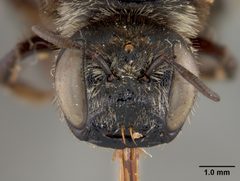
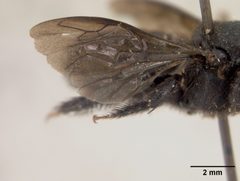
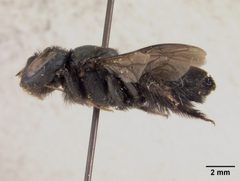
Pronunciation
How to pronounce Lithurgus: //laɪˈθɜːrɡəs//
These audio files are automatically generated. While they are not always 100% accurate, they are a good starting point.
Identification
Distinguished from other megachilid bees by their habit of excavating nesting tunnels in dead wood rather than using pre-existing cavities. Females carry pollen on the scopa (abdominal pollen brush) rather than on the hind legs. The is characterized by robust body form and mandibular modifications for wood excavation.
Images
Habitat
Dead wood, including dead branches and logs; forest edges; moist and warm environments. Some utilize gardens and anthropogenic .
Distribution
Native range centered on the Mediterranean Basin, extending through North Africa (Morocco, Algeria), southern and southern-central Europe, Asia Minor, the Caucasus, Central Asia to Central Siberia. Recent records document northward expansion into northern France, Poland, and Belarus. Several introduced to the Americas: L. chrysurus and L. huberi are established in North and South America.
Seasonality
season primarily July to August for temperate ; .
Diet
Pollen from Asteraceae (primarily Carduoideae: Carduus, Cirsium, Centaurea, Onopordum), also Cichorium, Helianthus, Taraxacum; Fabaceae (Onobrychis); Chenopodiaceae (Chenopodium); Boraginaceae (Echium). Feeding habits range from oligolectic to mesolectic/polylectic depending on and region.
Life Cycle
. Solitary nesting; females excavate tunnels in dead wood and construct 2-6 arranged linearly, each provisioned with pollen. Cells are lined with wood pulp and sealed with nest plugs of similar material.
Behavior
Excavates nesting tunnels in soft or dead wood using . Constructs partitions and nest plugs from wood pulp. Body position on flowers provides visual information that modulates interactions with other bees, including heterospecifics. Some show flexibility in body size in response to environmental and nutritional stress.
Ecological Role
of Asteraceae and other flowering plants. Wood-nesting contributes to decomposition processes in dead wood. Some serve as for cleptoparasitic bees (Stelis simillima, Stelis punctulatissima) and associated mites (Chaetodactylus spp.).
Human Relevance
Some have been introduced outside native ranges, potentially competing with native bees and managed honey bees. L. chrysurus and L. huberi are established in the Americas. Body size reductions in some have been linked to competition from managed honey bees and environmental stress.
Similar Taxa
- MegachileAlso in Megachilidae with scopa, but Megachile typically uses pre-existing cavities rather than excavating wood tunnels.
- AnthophoraWood-nesting apid bees that excavate tunnels, but Anthophora carries pollen on hind legs (corbiculae or scopae) rather than abdominal scopa.
Sources and further reading
- BugGuide
- Wikipedia
- GBIF taxonomy match
- iNaturalist taxon
- NCBI Taxonomy
- Catalogue of Life
- Nesting Biology and the Nest Architecture of Lithurgus (Lithurgus) collaris Smith (Hymenoptera: Megachilidae) on Iriomote Island, Southwestern Subtropical Archipelago, Japan
- First record of Lithurgus cornutus (Hymenoptera: Apoidea: Megachilidae) from Poland
- Sur la distribution en France de Lithurgus cornutus Fabricius 1827 (Hymenoptera - Megachilidae)
- Species status and new distribution records for Lithurgus huberi (Hymenoptera, Megachilidae, Lithurginae)
- Polarization Microscopy and Topochemistry of the Cocoon ofLithurgus chrysurus(Hymenoptera: Megachilidae)
- Nesting Biology and Foraging Ecology of the Wood-boring Bee Lithurgus chrysurus (Hymenoptera: Megachilidae)
- Figure 7 from: Gonzalez V, Engel M, Lucia M, Alvarez L (2013) Species status and new distribution records for Lithurgus huberi (Hymenoptera, Megachilidae, Lithurginae). Journal of Hymenoptera Research 30: 13-18. https://doi.org/10.3897/jhr.30.4018
- Figures 1–6 from: Gonzalez V, Engel M, Lucia M, Alvarez L (2013) Species status and new distribution records for Lithurgus huberi (Hymenoptera, Megachilidae, Lithurginae). Journal of Hymenoptera Research 30: 13-18. https://doi.org/10.3897/jhr.30.4018
- Early Nesting Biology of the Wood-Nesting Adventive Bee,Lithurgus chrysurusFonscolombe (Apoidea: Megachilidae: Lithurginae)
- Larval Development and Nesting Biology of the Adventive Wood-Nesting BeeLithurgus(L.)chrysurusFonscolombe (Hymenoptera: Megachilidae: Lithurgini)
- Multivariate discrimination among cryptic species of the mite genus Chaetodactylus (Acari: Chaetodactylidae) associated with bees of the genus Lithurgus (Hymenoptera: Megachilidae) in North America
- First report of nesting behaviour, pollen preference and seasonality of wood boring bee, Lithurgus atratus Smith in the reeds of Ipomoea carnea Jacq
- Seeking the flowers for the bees: Integrating biotic interactions into niche models to assess the distribution of the exotic bee species Lithurgus huberi in South America
- Behavioral Repertoires and Interactions between Apis mellifera (Hymenoptera: Apidae) and the Native Bee Lithurgus littoralis (Hymenoptera: Megachilidae) in Flowers of Opuntia huajuapensis (Cactaceae) in the Tehuacán Desert
- Behavioral Responses to Body Position in Bees: The Interaction of Apis mellifera and Lithurgus littoralis in Prickly Pear Flowers