
Lithurgus chrysurus
Fonscolombe, 1834
Mediterranean wood-boring bee, Golden-tailed Woodborer
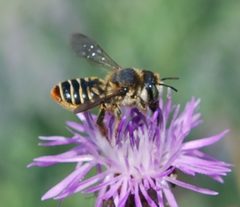
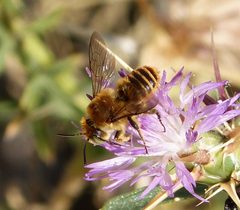
Lithurgus chrysurus is a wood-nesting megachilid native to the Mediterranean region that has established in North America. It is one of the few bees that excavates its own nesting tunnels in wood rather than using pre-existing cavities. The is , producing one per year, and constructs distinctive silk-lined cocoons for larvae.
Pronunciation
How to pronounce Lithurgus chrysurus: /lɪˈθɜːrɡəs krɪˈsʊərəs/
These audio files are automatically generated. While they are not always 100% accurate, they are a good starting point.
Images
Habitat
Wood-nesting; excavates tunnels in wooden substrates including dead branches, fence posts, and structural timber. Native to Mediterranean woodlands; occupy similar wooded in introduced range.
Distribution
Native: Europe and Northern Africa. (introduced): North America, with established documented in the northeastern United States.
Seasonality
; single per year with activity in summer and as prepupal larvae within cocoons.
Life Cycle
Complete with , larval, prepupal, and stages. Larvae develop within individual provisioned with pollen and nectar, then spin silk cocoons for . Cocoon structure comprises an outer layer of oriented, birefringent silk protein and an inner parchment-like layer; notably lacks the mucous layer produced by found in other Lithurginae.
Behavior
Excavates nesting tunnels directly into wood using , distinguishing it from most cavity-nesting megachilids that rely on pre-existing holes. Constructs multilayered silk cocoons with regionally variable thickness, particularly thicker at the rear zone.
Human Relevance
may interact with human structures through wood-nesting in fence posts and timber. Not known to be an economically significant pest.
Similar Taxa
- Other Lithurgus speciesShare wood-boring nesting habit and Lithurginae characteristics; L. chrysurus distinguished by geographic distribution and specific cocoon lacking secretions.
- Cavity-nesting Megachilidae (e.g., Osmia, Megachile)Similar -level traits in larval provisioning and cocoon construction, but differ fundamentally in nesting : L. chrysurus excavates wood actively rather than using pre-existing cavities.
More Details
Cocoon ultrastructure
Polarization microscopy reveals the cocoon wall contains macromolecularly oriented, positively birefringent silk protein layers. The rear zone shows complex multilayered thickening. and protein components show distinct topochemical distributions between outer and inner layers.
Adventive status
Documented as non-native in North America, with multiple studies focusing on nesting in its introduced range. Native Mediterranean serve as reference for comparing behavioral plasticity.
Sources and further reading
- BugGuide
- Wikipedia
- GBIF taxonomy match
- iNaturalist taxon
- NCBI Taxonomy
- Catalogue of Life
- Polarization Microscopy and Topochemistry of the Cocoon ofLithurgus chrysurus(Hymenoptera: Megachilidae)
- Nesting Biology and Foraging Ecology of the Wood-boring Bee Lithurgus chrysurus (Hymenoptera: Megachilidae)
- Early Nesting Biology of the Wood-Nesting Adventive Bee,Lithurgus chrysurusFonscolombe (Apoidea: Megachilidae: Lithurginae)
- Larval Development and Nesting Biology of the Adventive Wood-Nesting BeeLithurgus(L.)chrysurusFonscolombe (Hymenoptera: Megachilidae: Lithurgini)