
Lithurgopsis apicalis
(Cresson, 1875)
orange-tipped woodborer
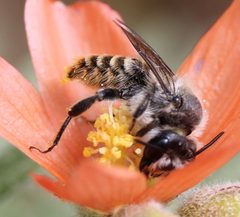
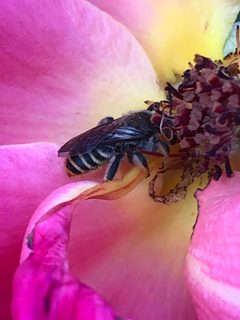
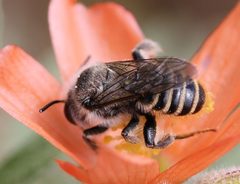
Lithurgopsis apicalis is a solitary woodborer in the Megachilidae, commonly known as the orange-tipped woodborer. are active that visit flowers of several plant families, particularly Cactaceae, Malvaceae, and Asteraceae. The nests in the hollow stalks of Agave plants, where females excavate tunnels and provision with pollen. It occurs across the southwestern United States and Mexico.
Pronunciation
How to pronounce Lithurgopsis apicalis: /lɪˌθɜːrˈɡɒpsɪs ˌæpɪˈkeɪlɪs/
These audio files are automatically generated. While they are not always 100% accurate, they are a good starting point.
Identification
The 'orange-tipped woodborer' suggests distinctive orange coloration at the abdominal apex, a trait that likely separates it from . As a member of Lithurgopsis, it possesses the robust characteristic of woodborer bees, adapted for excavating nesting tunnels in plant stems. Field identification to level requires examination of specific color patterns and genitalic .
Images
Habitat
Found in arid and semi-arid regions including desert scrub, chaparral, and oak-juniper woodlands. Nesting occurs specifically in the hollow or pithy stalks of Agave . Foraging includes areas with flowering cacti, mallows, and composites.
Distribution
Documented from the southwestern United States (Arizona, New Mexico, Texas) and Mexico. GBIF records indicate presence in Middle America and North America.
Seasonality
have been observed in late May and early June in the Davis Mountains of Texas. Activity likely extends through spring and early summer in most of its range, coinciding with flowering of plants.
Diet
feed on nectar and collect pollen from flowers of Cactaceae (including Opuntia engelmannii), Malvaceae, and Asteraceae. Larvae are provisioned with pollen in nest .
Host Associations
- Agave - nesting substrateNests built in hollow stalks
- Opuntia engelmannii - food plant observed foraging on flowers
Life Cycle
Solitary with typical megachilid development: females excavate nesting tunnels in Agave stalks, construct provisioned with pollen, lay , and seal cells. Larvae develop within cells, pupate, and emerge as . No detailed phenological data available.
Behavior
are foragers that visit flowers for nectar and pollen collection. Females exhibit woodboring to create nest tunnels. Males likely patrol flowering plants seeking mates.
Ecological Role
of desert and semi-desert flowering plants, particularly cacti and composites. Contributes to pollen transfer among plant in arid . As a stem-nesting , it creates cavities that may be reused by other cavity-nesting insects after abandonment.
Human Relevance
Of interest to researchers and pollination ecologists studying arid-land bee . No documented economic importance or pest status.
Similar Taxa
- Other Lithurgopsis speciesShared characteristics including robust and woodboring ; distinguished by specific color patterns and geographic range
- Other MegachilidaeShared traits of scopal pollen carriage and solitary nesting; Lithurgopsis distinguished by woodboring rather than cavity-nesting
More Details
Collecting notes
Specimens have been collected by netting from flowers of Opuntia engelmannii in the Davis Mountains, Texas, during late May to early June. The appears to be readily attracted to cactus flowers during peak bloom.