
Xorides peniculus
Townes, 1960
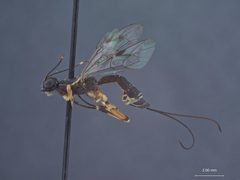
Xorides peniculus is a of ichneumon described by Townes in 1960. It belongs to the Xorides within the Ichneumonidae. The species has been documented in North America, including observations during the 2025 City Nature Challenge in the Kansas City metropolitan area. Like other members of its genus, it is presumed to be a of wood-boring larvae, though specific records for this species are not well documented.
Pronunciation
How to pronounce Xorides peniculus: /ksɔːˈriːdɛs pɛnɪˈkuːləs/
These audio files are automatically generated. While they are not always 100% accurate, they are a good starting point.
Identification
Members of the Xorides are characterized by their association with wood-boring beetles and typically possess elongated bodies with long . Females have a prominent, needle-like ovipositor used to penetrate wood and reach larvae. Specific diagnostic features distinguishing X. peniculus from require examination and are not readily available in general sources.
Images
Habitat
Has been observed in suburban residential settings with access to wooded areas or trees that may harbor wood-boring beetles. The Kansas City observation occurred at a blacklight sheet in a front yard, suggesting activity and attraction to light.
Distribution
Documented from North America. Specific records include Leavenworth County, Kansas. The has 15 observations recorded on iNaturalist, indicating it is rarely encountered or underreported.
Seasonality
One documented observation occurred in late April (April 27-30, 2025), suggesting spring activity. indicated by blacklight attraction.
Host Associations
- Wood-boring beetles (presumed) - Based on -level ; specific for X. peniculus not documented
Behavior
, as evidenced by attraction to blacklight. Females presumably search for wood-boring larvae in tree trunks and branches, using their elongated ovipositor to deposit through wood onto .
Ecological Role
Presumed of wood-boring beetles, potentially contributing to natural regulation of in forest and woodland .
Human Relevance
Documented during citizen science events (City Nature Challenge), contributing to biodiversity records. No known direct economic or medical significance.
Similar Taxa
- Podoschistus vittifronsFormerly classified in Xorides; similar size, shape, and wood-associated . Distinguished by taxonomic revision and identification.
- Rhyssa spp.Similar large size, elongated body form, and tree-trunk searching in females; distinguished by antennal structure and ovipositor .
More Details
Taxonomic History
The Xorides has undergone taxonomic revision, with some former members (such as Podoschistus vittifrons) reassigned to other genera. This complicates literature searches for biological information.