
Exeristes
Förster, 1869
Species Guides
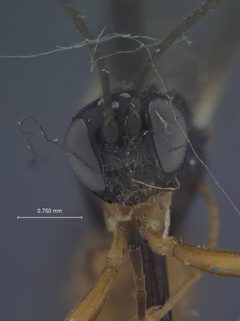
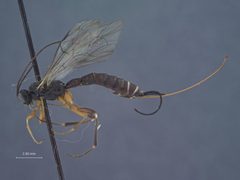
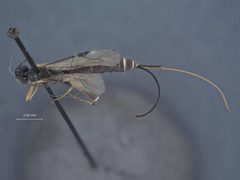
1Exeristes is a of ichneumon wasps ( Ichneumonidae) containing approximately nine described . Species in this genus are ectoparasitoids of insect larvae. Exeristes roborator has been extensively studied for its associative learning abilities, demonstrating capacity to learn olfactory and visual cues associated with microhabitats. E. comstockii has been used in nutritional studies examining dietary requirements for .
Pronunciation
How to pronounce Exeristes: //ɛks.ɛˈɹɪs.tiːz//
These audio files are automatically generated. While they are not always 100% accurate, they are a good starting point.
Images
Distribution
Records indicate presence in Denmark, Norway, Sweden, and the United States (Vermont). Additional -level distributions include: E. roborator in the Carpathian Basin; E. kamrupa in India; E. shanxiensis in China (Shanxi).
Host Associations
- Galleria mellonella - Used in laboratory studies for E. comstockii; females can recover ovarian function when fed tissues after vitamin starvation.
- Pink bollworm (Pectinophora gossypiella) - E. roborator has been studied as a bio-agent against diapausing larvae.
- Diplolepis galls - /E. roborator occurs in the associated with Diplolepis galls in the Carpathian Basin; specific relationships within galls not detailed.
Behavior
Females of E. roborator demonstrate associative learning of microhabitat cues. Learning of olfactory stimuli occurs when females encounter hosts in association with specific odors. Visual learning of host microhabitat color has also been demonstrated. Learning ability is age-dependent: females conditioned immediately after show higher participation, intensity, and longer duration (approximately 7 days) of learned than those conditioned 5–10 days after eclosion. Prior conditioning to specific can impair subsequent host habitat location in some contexts.
Ecological Role
Ectoparasitoid of insect larvae.
Human Relevance
E. roborator has been investigated for potential use in programs, particularly against pink bollworm. Laboratory studies suggest that carefully controlled associative learning could improve of location by released for biological control. E. comstockii has been used extensively in nutritional research to determine dietary requirements for parasitoid , informing protocols for holding parasitoids before release.
Sources and further reading
- BugGuide
- Wikipedia
- GBIF taxonomy match
- iNaturalist taxon
- NCBI Taxonomy
- Catalogue of Life
- Learning of host microhabitat colour by Exeristes roborator (F.) (Hymenoptera: Ichneumonidae)
- FATTY ACID COMPOSITION OF EXERISTES COMSTOCKII (CRESS) REARED ON DIFFERENT HOSTS
- Detrimental effect of prior conditioning on host habitat location by Exeristes roborator
- AGE-DEPENDENT ASSOCIATIVE LEARNING BY EXERISTES ROBORATOR (F.) (HYMENOPTERA: ICHNEUMONIDAE)
- Aspects of amino acid metabolism and nutrition in the ectoparasitoid wasp, Exeristes roborator
- Defined Meridic and Holidic Diets and Aseptic Feeding Procedures for Artificially Rearing the Ectoparasitoid Exeristes roborator (Fabricius)1
- Effects of Dietary Components on Fecundity of the ParasitoidExeristes comstockii(Cress.) (Hymenoptera: Ichneumonidae)
- Role of Ten Dietary Vitamins on Fecundity of the ParasitoidExeristes comstockii(Cresson) (Hymenoptera: Ichneumonidae)
- Effect of Prior Experience on the Response of Exeristes roborator (Hymenoptera: Ichneumonidae) to a Natural Host and Microhabitat in a Seminatural Environment
- EFFECTS OF DIETARY AMINO ACIDS, SALTS, AND PROTEIN STARVATION ON FECUNDITY OF THE PARASITOIDEXERISTES COMSTOCKII(HYMENOPTERA: ICHNEUMONIDAE)
- Learning of an olfactory stimulus associated with a host microhabitat by Exeristes roborator
- Exeristes roborator (Fabricius, 1793) (Hymenoptera: Ichneumonidae) in the parasitoid community of Diplolepis galls in the Carpathian Basin
- The amino acid requirements for larval development of the hymenopterous parasitoid Exeristes roborator fabricius (hymenoptera: Ichneumonidae)
- SEASONAL ACTIVITY OF THE ECTOPARASITOIDS Exeristes roborator (F.)AND Parasierola SP. AS BIO-AGENTS AGAINST THE DIAPAUSING PINK BOLLWORM LARVAE.
- Characterization of the phospholipids in the insect parasite, Exeristes roborator (Fabricius) and the effects of dietary glucose on their distribution