
Trogus lapidator
(Fabricius, 1787)
Trogus lapidator is an ichneumonid that develops within the pupae of the Old World swallowtail Papilio machaon. It is notable for an unusual mechanism: rather than cutting through the pupal case with like most related wasps, it primarily uses a liquid secretion to soften and dissolve host tissue, employing mandibles only secondarily to spread the secretion and minimally enlarge the exit hole at the end of emergence. The occurs across Europe, with records from Finland to Belgium and Canada.
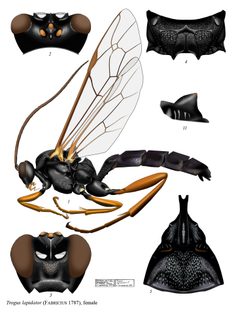
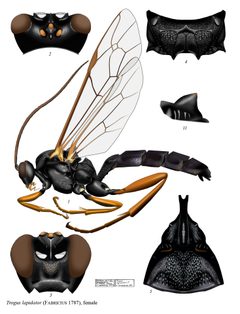
Pronunciation
How to pronounce Trogus lapidator: /ˈtroː.ɡus ˌla.pɪˈdaː.tor/
These audio files are automatically generated. While they are not always 100% accurate, they are a good starting point.
Images
Distribution
Europe (including Finland, Belgium), with additional records from Canada (Alberta, British Columbia).
Host Associations
- Papilio machaon - Develops within pupa; emerges from pupal stage, killing the host
Life Cycle
Development occurs within the pupa of its ; emerges from host pupa.
Behavior
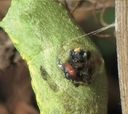
Unusual mechanism: creates exit hole through pupal wing case primarily using a liquid secretion that softens and disintegrates host tissue. are used mainly to spread this secretion rather than to cut mechanically. Only at the very end of emergence are mandibles employed minimally to enlarge the hole. This contrasts with the typical cap-cutting emergence of most other Ichneumonidae from Lepidoptera pupae.
Ecological Role
of papilionid butterflies; regulator of Papilio machaon.
Sources and further reading
- BugGuide
- Wikipedia
- GBIF taxonomy match
- iNaturalist taxon
- NCBI Taxonomy
- Catalogue of Life
- Figure 1–10 from: Shaw MR, Kan P, Kan-van Limburg Stirum B (2015) Emergence behaviour of adult Trogus lapidator (Fabricius) (Hymenoptera, Ichneumonidae, Ichneumoninae, Heresiarchini) from pupa of its host Papilio machaon L. (Lepidoptera, Papilionidae), with a comparative overview of emergence of Ichneumonidae from Lepidoptera pupae in Europe. Journal of Hymenoptera Research 47: 65-85. https://doi.org/10.3897/JHR.47.6508
- <i>Trogus lapidator</i> ( Fabricius) ssp. <i>panzeri</i> Carlson (Hymenoptera, lchneumonidae) in Finland: new rearing records and comments on its distribution
- Emergence behaviour of adult Trogus lapidator (Fabricius) (Hymenoptera, Ichneumonidae, Ichneumoninae, Heresiarchini) from pupa of its host Papilio machaon L. (Lepidoptera, Papilionidae), with a comparative overview of emergence of Ichneumonidae from Lepidoptera pupae in Europe