
Mesoleius
Holmgren, 1857
Species Guides
2- Mesoleius submarginatus
- Mesoleius tenthredinis(larch sawfly parasite)
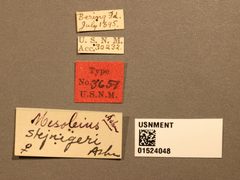
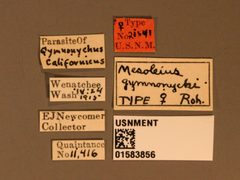
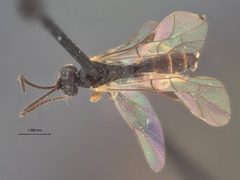
Mesoleius is a of ichneumonid containing at least 160 described . The genus is best known from detailed studies of Mesoleius tenthredinis, a agent introduced to North America to manage larch sawfly . Species in this genus are endoparasitoids of larvae, with females depositing directly into cocoons or larvae. The genus has been documented from Europe and North America.
Pronunciation
How to pronounce Mesoleius: /mɛˈsoʊ.liː.i.əs/
These audio files are automatically generated. While they are not always 100% accurate, they are a good starting point.
Images
Habitat
Associated with forested environments where occur; specifically within host cocoons and larval of tenthredinid sawflies.
Distribution
Documented from Denmark, Norway, and Sweden; introduced and established in southern Manitoba, Canada; additional North American records associated with introductions.
Host Associations
- Pristiphora erichsonii - primary Larch sawfly; develop and hatch within larvae in approximately 120 hours at 23°C in British Columbia and Newfoundland
- Pristiphora erichsonii - with immune resistanceManitoba and Saskatchewan exhibit , preventing successful development
- Lugaeonematus erichsoni - Target for introduction in southern Manitoba
Life Cycle
are oval and pale yellow, deposited singly in cocoons. Embryonic development includes superficial cleavage, formation, germ band development with condensation and segmentation, and organogenesis of , gut, and body wall. Normal is 7 to 10 days. Development occurs entirely within the host larva.
Behavior
Females oviposit into cocoons. Embryos exhibit intercellular pole reentry just before gastrulation. Encapsulated embryos can remain viable for extended periods—some up to seven months after oviposition—though viability decreases with age. Unencapsulated embryos develop more rapidly than encapsulated ones when removed from host.
Ecological Role
of tenthredinid larvae; acts as agent regulating sawfly . The -parasitoid interaction demonstrates geographic variation in effectiveness due to regional host immune responses.
Human Relevance
Used as a agent against the larch sawfly (Pristiphora erichsonii), a forest pest in North America. Introduction to southern Manitoba was documented, though effectiveness is limited in Manitoba and Saskatchewan due to immune responses. Remains effective in British Columbia where host lack this resistance.
Similar Taxa
- Pimpla turionellaeSimilar embryogenesis pattern; both exhibit primitive endoparasitoid development with reduced periplasm, proliferation of middle plate after lateral plate overgrowth, and anal opening formation. Distinguished by M. tenthredinis having no amnion and incorporation of deutoplasmic in serosal cells.
- Banchus femoralisBoth are monembryonic ichneumonids, but M. tenthredinis embryogenesis differs in formation patterns and germ band development.
- Diadegma vestigialisBoth are monembryonic ichneumonids; M. tenthredinis exhibits distinct embryological features including different middle plate proliferation timing and serosal cell composition.
More Details
Host immune encapsulation
of Pristiphora erichsonii from Manitoba and Saskatchewan exhibit a natural immune response to M. tenthredinis involving phagocytic capsule formation around embryos. This response does not occur in British Columbia populations, explaining regional variation in effectiveness. The capsule consists of both cellular (outer) and non-cellular (inner) regions containing mucopolysaccharide, and is hypothesized to inhibit parasitoid development by interfering with oxygen supply.
Putative viral association
A virus resembling has been observed in the ovarial calyx tissue of M. tenthredinis females. show morphological similarity to typical baculoviruses, with apparent uncoating of at nuclear pores. The viral may be circular and of high molecular weight. This '' has been present in all females examined, though its functional significance remains unconfirmed.
Embryological significance
Detailed embryological studies of M. tenthredinis have contributed to understanding of development. The mode of embryonal development indicates that M. tenthredinis and Pimpla turionellae represent primitive endoparasitoids within Ichneumonidae, with distinctive features including extension of the germ anlage tail end to produce a anal opening and complete deutoplasmic envelope formation surrounding the embryo.
Sources and further reading
- BugGuide
- GBIF taxonomy match
- iNaturalist taxon
- NCBI Taxonomy
- Catalogue of Life
- EMBRYOGENESIS OF MESOLEIUS TENTHREDINIS MORL. (HYMENOPTERA: ICHNEUMONIDAE)
- A putative baculovirus in the ichneumonid parasitoid, Mesoleius tenthredinis
- THE INTRODUCTION AND ESTABLISHMENT OF THE LARCH SAWFLY PARASITE, MESOLEIUS TENTHREDINIS MORLEY, INTO SOUTHERN MANITOBA (HYMEN.)
- THE CAPSULE AND ITS RELATION TO THE EMBRYOGENESIS OF THE ICHNEUMONID PARASITOID MESOLEIUS TENTHREDINIS MORL. IN THE LARCH SAWFLY, PRISTIPHORA ERICHSONII (HTG.) (HYMENOPTERA:TENTHREDINIDAE)
- THE NATURAL IMMUNITY OF THE LARCH SAWFLY (PRISTIPHORA ERICHSONII (HTG.)) TO THE INTRODUCED PARASITE MESOLEIUS TENTHREDINIS MORLEY, IN MANITOBA AND SASKATCHEWAN