
Temelucha interruptor
(Gravenhorst, 1829)
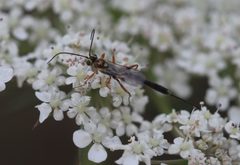
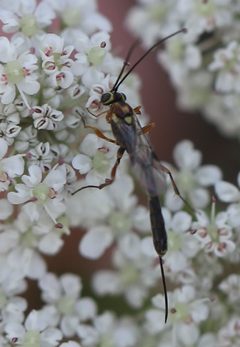
Temelucha interruptor is a in the Ichneumonidae that attacks larvae of the pine shoot moth (Rhyacionia buoliana). The has been introduced to North America for but exhibits problematic by preferentially attacking larvae already parasitized by the braconid wasp Orgilus obscurator. This interference reduces the effectiveness of biological control programs targeting R. buoliana. The species is native to Europe, with established in Denmark and Sweden, and has been recorded in the conterminous United States.
Pronunciation
How to pronounce Temelucha interruptor: /tɛ.mɛˈluː.kʰa ɪn.tɛrˈrʊp.tɔr/
These audio files are automatically generated. While they are not always 100% accurate, they are a good starting point.
Images
Habitat
Associated with pine forests and plantations where the Rhyacionia buoliana occurs. Specific microhabitat requirements are not documented.
Distribution
Native to Europe (Denmark, Sweden). Introduced and established in North America (conterminous United States).
Host Associations
- Rhyacionia buoliana (Schiff.) - primary Lepidoptera: Olethreutidae; pine shoot moth larvae
- Orgilus obscurator (Nees) - indirect interactionBraconidae; T. interruptor preferentially attacks R. buoliana larvae previously parasitized by O. obscurator
Behavior
Females preferentially attack larvae that have been previously parasitized by Orgilus obscurator rather than unparasitized hosts. They also show preference for buds previously visited by O. obscurator females, suggesting use of chemical or physical cues left by the competing .
Ecological Role
Primary of pine shoot moth larvae. Acts as a facultative hyperparasitoid or competitor through its preference for previously parasitized , thereby interfering with efforts that rely on Orgilus obscurator.
Human Relevance
Introduced to North America as a agent for Rhyacionia buoliana. The introduction is now considered unwise due to the ' interference with established biological control by Orgilus obscurator.
Similar Taxa
- Orgilus obscuratorBoth are of Rhyacionia buoliana; O. obscurator is a braconid that T. interruptor displaces through preferential attack of already-parasitized .
- Other Temelucha species such as T. bernardina, T. eremica, T. manifesta, T. morongana, and T. vitellina share -level and likely similar , but specific distinguishing features are not documented in available sources.
Sources and further reading
- BugGuide
- GBIF taxonomy match
- iNaturalist taxon
- Catalogue of Life
- temelucha_bernardina_dasch_holotype_female_ucrc_ent_283770_propodeum.jpg | Entomology Research Museum
- Primary Type List | Entomology Research Museum
- The Interaction Between Orgilus obscurator (Nees) (Hymenoptera: Braconidae) and Temelucha interruptor (Grav.) (Hymenoptera: Ichneumonidae), Parasites of the Pine Shoot Moth, Rhyacionia buoliana (Schiff.) (Lepidoptera: Olethreutidae)