
Cotesia empretiae
(Viereck, 1913)
Saddleback Caterpillar Parasitoid Wasp
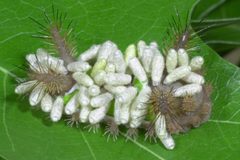
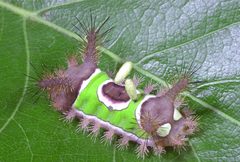
Cotesia empretiae is a small in the Braconidae that specializes in attacking caterpillars, particularly the saddleback caterpillar (Acharia stimulea). Females hunt actively on foliage, using their ovipositor to deposit inside caterpillars. The wasp larvae develop internally, eventually emerging through the host's skin to spin characteristic white silk cocoons on the exterior. Like other Cotesia , this wasp transmits a during oviposition that suppresses the host's immune system, enabling successful parasitoid development.
Pronunciation
How to pronounce Cotesia empretiae: /koˈtɛs.i.a ɛmˈprɛt.i.a/
These audio files are automatically generated. While they are not always 100% accurate, they are a good starting point.
Identification
Distinguished from similar Cotesia primarily by association with Acharia stimulea (saddleback caterpillar) and geographic distribution. The clustered white cocoons on the surface of host caterpillars are characteristic of Cotesia generally; specific identification of the requires examination of morphological features not detailed in available sources. C. empretiae appears to be specifically associated with saddleback caterpillars rather than the hosts of C. congregata.
Images
Appearance
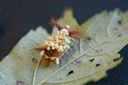
Tiny with slender body typical of braconid . are small enough to be easily overlooked, with proportions suited for maneuvering among leaves and stems. The white silk cocoons spun by larvae are highly visible against caterpillars, appearing as small, oval, densely clustered objects.
Habitat
Found in supporting its caterpillar, including forests, gardens, and areas with diverse woody and herbaceous vegetation. Host plants include oaks, elms, lindens, apples, plums, corn, blueberries, grapes, and irises. hunt actively on foliage where host caterpillars feed.
Distribution
Recorded as present in North America and South America. Specific range details within these continents are not documented in available sources.
Seasonality
Activity corresponds with presence of caterpillars. In temperate regions, saddleback caterpillars are active during summer months, suggesting activity peaks during this period. No specific data available for this .
Diet
Larval development occurs within living caterpillars, with larvae feeding on host tissues. have been observed feeding on honey in laboratory settings; natural adult food sources are not documented.
Host Associations
- Acharia stimulea - primary Saddleback caterpillar; deposited inside caterpillar, larvae emerge and spin cocoons on exterior
Life Cycle
Females locate caterpillars on foliage and use their ovipositor to deposit inside. During oviposition, females inject a that suppresses the host's immune system. Eggs hatch and larvae develop internally, feeding on host tissues. Upon completing development, larvae burrow through the host's skin and spin white silk cocoons on the exterior surface. occurs within these cocoons, after which emerge to mate and seek new hosts.
Behavior
Females actively hunt for caterpillars on vegetation, jumping aboard encountered hosts. Rapid oviposition involves multiple stings with the ovipositor to deposit . After from cocoons, immediately seek mates and new host caterpillars. Parasitized host caterpillars typically remain alive until larvae emerge.
Ecological Role
agent regulating of stinging caterpillars. Acts as a natural enemy that can significantly reduce saddleback caterpillar numbers in local areas. Part of a broader guild of attacking urticating caterpillars.
Human Relevance
Provides natural of the saddleback caterpillar, a whose venomous spines cause painful stings and allergic reactions in humans. Reduces encounters between humans and stinging caterpillars in gardens and recreational areas. No direct negative impacts on humans documented; are too small to sting humans.
Similar Taxa
- Cotesia congregataAlso parasitizes caterpillars and produces similar white cocoons, but primarily attacks hornworms (Manduca spp.) rather than saddleback caterpillars
- Other Cotesia speciesMany in share similar and cocoon appearance; differentiation requires association and morphological examination
Misconceptions
The white cocoons on caterpillars are sometimes mistaken for of the or eggs of some other mysterious enemy; they are actually pupal cocoons spun by mature larvae after emerging from the host.
More Details
Polydnavirus symbiosis
Like other Cotesia , C. empretiae transmits a during oviposition. This virus integrates into the and is injected with , where it expresses proteins that disable the caterpillar's immune defenses. This mutualism is essential for successful development.
Taxonomic note
The epithet 'empretiae' appears to derive from an older generic placement (Empretia); the species was described by Viereck in 1913 and later transferred to Cotesia.
Sources and further reading
- BugGuide
- GBIF taxonomy match
- iNaturalist taxon
- NCBI Taxonomy
- Catalogue of Life
- To sting a stinger: Saddleback caterpillar, Acharia stimulae, and brachonid wasp, Cotesia — Bug of the Week
- Weeding can turn spicy when saddlebacks are around: Saddleback caterpillar, Acharia stimulae — Bug of the Week
- Stinging caterpillars - White flannel moth, Norape ovina, and Saddleback caterpillar, Archaria stimulea — Bug of the Week
- Tough to be a hornworm: Tomato and tobacco hornworms, Manduca quinquemaculata and M. sexta — Bug of the Week
- This Artificial Diet May Make Insect Rearing Easier
- Biological Control in Brazil is Used on an Area that is Larger than Belgium