
Helconinae
Genus Guides
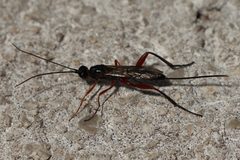
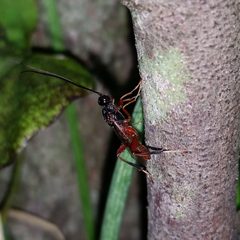
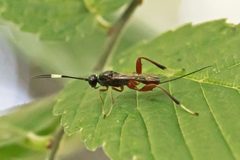
2Helconinae is a of in the Braconidae. Historically encompassing approximately 40 across 4 tribes, the subfamily has undergone substantial taxonomic revision. Following the elevation of Cenocoeliini to subfamily status in 1984 and the transfer of Brachistini and Diospilini to Brachistinae in 2011, the subfamily now comprises three tribes: Helconini, Ussurohelconini, and Vervoortihelconini, with approximately 12 genera. Members are known to parasitize wood-boring beetles, particularly cerambycids.
Pronunciation
How to pronounce Helconinae: /hɛlˈkoʊnɪniː/
These audio files are automatically generated. While they are not always 100% accurate, they are a good starting point.
Identification
Helconinae can be distinguished from the related Brachistinae by the retention of tribe Helconini and exclusion of Brachistini and Diospilini. Within Helconinae, tribes are distinguished by morphological characters of the metasomal ; for example, Vervoortihelconini exhibits in tergite number (4 in females, 5 in males). The subfamily differs from Cenocoeliinae by the exclusion of tribe Cenocoeliini.
Images
Habitat
Associated with forested environments, particularly coniferous forests. Vervoortihelcon scaramozzinoi has been recorded from Podocarpus trees in Chile. relationships suggest association with woody vegetation supporting cerambycid beetle .
Distribution
Global distribution with documented records from Iran (9 in 5 ), Chile, Vietnam, and other regions. The genus Wroughtonia is present in Vietnam. The has been observed on iNaturalist with 1355 observations indicating broad geographic presence.
Host Associations
- Stenorhopalus rubiginus - Cerambycidae: Coleoptera; first record for Vervoortihelcon scaramozzinoi in Chile
Life Cycle
of wood-boring beetles. details are -specific and poorly documented at the level.
Behavior
of wood-boring cerambycid beetles has been documented. Specific behavioral traits at the level are not well characterized.
Ecological Role
regulating of wood-boring beetles, particularly cerambycids, in forest .
Similar Taxa
- BrachistinaeFormerly included within Helconinae; separated in 2011 based on phylogenetic analysis, now contains tribes Brachistini and Diospilini
- CenocoeliinaeFormerly included tribe Cenocoeliini; elevated to status in 1984 by van Achterberg
More Details
Taxonomic Instability
The has experienced repeated reclassification. The tribe Ussurohelconini was previously transferred to Cenocoeliinae but subsequently recovered as a tribe of Helconinae. The subtribe Vervoortihelconina was elevated to tribal status as Vervoortihelconini.
Iranian Fauna
The Iranian fauna comprises 9 in 5 and 2 tribes, with three species (Aspicolpus carinator, Diospilus capito, Diospilus productus) newly recorded in a 2016 catalogue.
Sources and further reading
- BugGuide
- Wikipedia
- iNaturalist taxon
- NCBI Taxonomy
- An annotated catalogue of the Iranian Euphorinae, Gnamptodontinae, Helconinae, Hormiinae and Rhysipolinae (Hymenoptera: Braconidae)
- First host record and morphological notes on the rare Chilean wasp Vervoortihelcon scaramozzinoi van Achterberg (Hymenoptera, Braconidae, Helconinae, Vervoortihelconini)
- Addition to the review of the genus Wroughtonia Cameron, 1899 (Hymenoptera, Braconidae, Helconinae) from Vietnam: Description of two new species
- Figures 1-7 from: Quicke DLJ, Ward DF, Butcher BA (2019) First host record and morphological notes on the rare Chilean wasp Vervoortihelcon scaramozzinoi van Achterberg (Hymenoptera, Braconidae, Helconinae, Vervoortihelconini). Journal of Hymenoptera Research 68: 13-16. https://doi.org/10.3897/jhr.68.32954
- The genus Ussurohelcon Belokobylskij (Hymenoptera, Braconidae, Helconinae) in Vietnam, with descriptions of six new species.