
Elasmosoma
Ruthe, 1858
Species Guides
2Elasmosoma is a small of - in the Braconidae, Euphorinae, tribe Neoneurini. are minute, typically under 2.0 mm in length, and are specialized of Formicidae ants. Females attack in , alighting briefly to oviposit into the . The genus comprises approximately 13 described species distributed across the Northern Hemisphere, with records from Europe, Asia, and North America. The host- association represents a well-balanced system that has persisted for at least 40 million years.
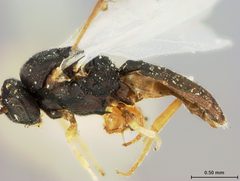

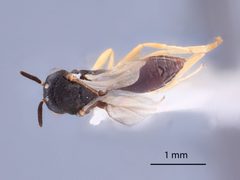
Pronunciation
How to pronounce Elasmosoma: /ɛlɑsmoʊˈsoʊmə/
These audio files are automatically generated. While they are not always 100% accurate, they are a good starting point.
Identification
Distinguished from other Neoneurini by female hypopygium : deep medial emargination creating two "prong-like" projections. Separated from congeneric euphorine braconids by -specific association and aerial oviposition . Differs from ichneumonid ant (e.g., Hybrizon, Kollasmosoma) in -level characters: braconids have first metasomal segment with second (petiole absent), reduced wing venation with no areolet in forewing, and first instar larvae develop inside ants rather than in ant larvae.
Images
Appearance
Minute , body length typically under 2.0 mm. Female hypopygium (terminal abdominal segment) possesses distinctive structures: deep medial emargination producing two "prong-like" projections, a diagnostic feature for the . Body form compact, adapted for aerial attack on mobile . Wings present and functional for . Coloration generally dark, though specific pigmentation varies among .
Habitat
Diverse supporting , including: coastal sand dunes, forested areas, and agricultural orchards. Specific documented habitats include pear orchards in Xinjiang, China; coastal sand dune systems in central Oregon, USA; and various European localities. Association with ant nests of Formica and related is the primary habitat determinant.
Distribution
Northern Hemisphere distribution. Documented from: Europe (Albania, Austria, Bulgaria, Croatia, Denmark, Finland, France, Germany, Greece, Hungary, Italy, Macedonia, Moldova, Netherlands, Poland, Russia, Slovakia, Slovenia, Sweden, United Kingdom), Asia (China, Iran, Japan, Kazakhstan, Mongolia, Tajikistan, Taiwan, Turkey), and North America (USA). GBIF records confirm presence in Denmark, Norway, and Sweden.
Host Associations
- Formica obscuriventris clivia - primary Major ants parasitized by Elasmosoma sp. near pergandei in Oregon
- Formica rufibarbis - primary of Elasmosoma luxemburgense; filmed oviposition attacks
- Formica fusca - primary Cited for Elasmosoma berolinense
- Formica rufa - primary Cited for Elasmosoma berolinense
- Formica rufa japonica - primary Cited for Elasmosoma berolinense in Japan
- Formica pratensis - primary Cited for Elasmosoma berolinense
- Formica sanguinea - primary Cited for Elasmosoma berolinense
- Lasius niger - primary Cited for Elasmosoma berolinense
- Camponotus vagus - primary Cited for Elasmosoma berolinense
Life Cycle
Endoparasitic development within . Embryonic development occurs inside the serosal or trophamnion of the in the host . First instar larvae possess specialized : large capsule with falcate , 11 body lobes, elongate tail, and dorsally located . Second instar larvae are unspecialized, lacking the distinctive features of the first instar. Third instar larvae are hymenopteriform with distinct head capsule. occurs within host; cocoon formation precedes adult . Mechanism of emergence from ant nest unresolved; possibly facilitated by deposition of dead ants outside nest entrances.
Behavior
Females exhibit specialized aerial attack : approach ants in and alight briefly on the host to oviposit into the . This requires precise flight control and rapid oviposition to overcome defensive behaviors. Parasitized ants display altered behavior, though specific modifications are not detailed. The flight attack tactic represents a remarkable to circumvent the defenses of , well-equipped ant colonies.
Ecological Role
of Formicidae ants. Functions as a agent of at local . The - system represents a well-balanced evolutionary association persisting for at least 40 million years, indicating long-term coevolutionary stability. As a hyperparasitoid or primary parasitoid of ecologically ants, may influence ant colony dynamics and competitive interactions in ant .
Human Relevance
Potential utility in of pest , though not currently deployed for this purpose. Scientific interest centers on the remarkable behavioral and morphological adaptations enabling of ants. Subject of research on - and the evolutionary stability of intimate associations.
Similar Taxa
- NeoneurusCongeneric euphorine braconid ; differs in hypopygium structure and specific ant associations (e.g., Formica cunicularia for N. vesculus)
- HybrizonIchneumonid with superficially similar aerial attack ; differs in characters (first metasomal segment not , different larval development in ant larvae rather than ants)
- KollasmosomaIchneumonid with aerial oviposition; differs in -level characters and larval development site (ant larvae vs. ants)
More Details
Fossil history
The tribe Neoneurini, to which Elasmosoma belongs, has an evolutionary history spanning at least 40 million years, indicating the antiquity of the braconid- association.
Species diversity
The comprises approximately 13 described globally, with new species continuing to be described (e.g., Elasmosoma michaeli Shaw, 2007; Elasmosoma depressum van Achterberg & Koponen, 2003). Chinese fauna remains underexplored, with recent first records suggesting additional undiscovered species.
Research methods
Study of these is challenging due to minute size and specialized . Successful documentation has employed Malaise trapping in -inhabited and direct filming of attacks, with video evidence published as supplementary material.
Sources and further reading
- BugGuide
- Wikipedia
- GBIF taxonomy match
- iNaturalist taxon
- NCBI Taxonomy
- Catalogue of Life
- Uncategorized | Blog - Part 54
- Death from above: parasite wasps filmed for the first time attacking ants from the air | Blog
- Two new records from China: Aphaereta (Atopandrium) debilitata Morley and Elasmosoma berolinense Ruthe (Hymenoptera, Braconidae)
- Behaviour and development of Elasmosoma sp. (Neoneurinae: Braconidae: Hymenoptera), an endoparasite of Formica ants (Formicidae: Hymenoptera)