
Schizoprymnus
Förster, 1863
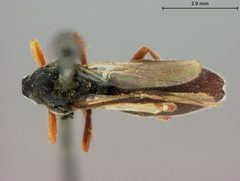
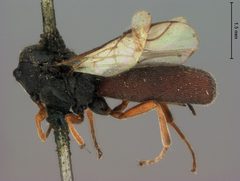
Schizoprymnus is a of braconid in the Brachistinae, comprising 126 extant distributed worldwide except the Neotropical region. Species are ovo-larval koinobiont endoparasitoids of coleopterous larvae, particularly weevils and related . The genus is characterized by a distinctive formed by the fusion of the three metasomal tergites.

Pronunciation
How to pronounce Schizoprymnus: /ˌskɪzoʊˈprɪmnəs/
These audio files are automatically generated. While they are not always 100% accurate, they are a good starting point.
Identification
Distinguished from other Brachistinae by the formed from the first three metasomal tergites without . -level identification requires examination of antennal segment count, ovipositor length relative to metasoma, leg coloration, and detailed sculpturing of the carapace and propodeum. For example, S. cani differs from S. telengai by having 20–21 antennal segments (vs. 14–18), ovipositor sheath 1.17× longer than metasoma (vs. 0.5×), and reddish-yellow legs (vs. dark).
Images
Habitat
Natural reserves and mountainous regions; specimens collected in forested and scrubland using sweeping nets and . Chinese records include Kuankuoshui Natural Reserve (Guizhou) and West Tianmu Mountain (Zhejiang).
Distribution
Worldwide distribution except the Neotropical region. Recorded from Palaearctic (including China: Jilin, Liaoning, Inner Mongolia, Ningxia, Hebei, Hunan, Fujian, Zhejiang, Sichuan, Taiwan, Guizhou; Turkey; Scandinavia), Afrotropical, Oriental, Nearctic, and Australasian regions. GBIF records from Denmark, Norway, and Sweden.
Host Associations
- Larvae of Coleoptera: Apionidae - ovo-larval koinobiont endoparasitoid
- Larvae of Coleoptera: Brentidae - ovo-larval koinobiont endoparasitoid
- Larvae of Coleoptera: Chrysomelidae - ovo-larval koinobiont endoparasitoid
- Larvae of Coleoptera: Curculionidae - ovo-larval koinobiont endoparasitoid
- Larvae of Coleoptera: Mordellidae - ovo-larval koinobiont endoparasitoid
Life Cycle
Ovo-larval koinobiont endoparasitoid: are laid into larvae, and development proceeds within the living host, which continues to feed and grow during development.
Ecological Role
of larvae, contributing to of coleopteran . Potential value in of weevil and leaf beetle pests.
Human Relevance
Potential agent for pest Coleoptera, particularly weevils (Curculionidae, Brentidae, Apionidae) and leaf beetles (Chrysomelidae). No direct negative impacts on humans recorded.
Similar Taxa
- Other Brachistinae generaSchizoprymnus is distinguished by the of the first three metasomal tergites without transverse ; related typically have movable tergites or different fusion patterns.
More Details
Taxonomic history
The was established by Förster in 1863. Recent taxonomic work has described numerous new , particularly from China, indicating the genus remains incompletely documented.
Collection methods
Specimens have been collected using sweeping nets and , suggesting are active in vegetation and fly at moderate heights.
Sources and further reading
- BugGuide
- GBIF taxonomy match
- iNaturalist taxon
- NCBI Taxonomy
- Catalogue of Life
- Contribution to the parasitoid fauna of Turkey with a new brachistine species, Schizoprymnus (Schizoprymnus) cani Koldaş sp. n. (Braconidae: Brachistinae: Hymenoptera)
- The Genus Schizoprymnus Förster, 1863 (Hymenoptera, Braconidae, Brachistinae) from China, with Descriptions of Seven New Species.