
Dinotrema
Förster, 1862
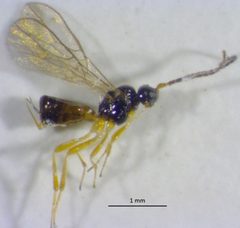
Dinotrema is a large of braconid wasps comprising approximately 350 described worldwide. Members are among the largest in the tribe Alysiini. The genus is characterized by distinctive morphological features of the and wing venation that separate it from related genera. Species are koinobiont endoparasitoids, primarily attacking larval Diptera.
Pronunciation
How to pronounce Dinotrema: //dɪˈnɒtrɛmə//
These audio files are automatically generated. While they are not always 100% accurate, they are a good starting point.
Identification
Tridentate, small . Paraclypeal fovea short, not reaching edge of . cuqu1 (2-SR) present and sclerotized; nervulus (cu-a) postfurcal. Distinguished from Aspilota by short paraclypeal fovea far separated from inner margin of eye. Distinguished from Synaldis and Adelphenaldis by presence of vein cuqu1 (2-SR) combined with short paraclypeal fovea.
Images
Distribution
across major biogeographic regions: Afrotropical, Australasian, Nearctic, Neotropical, Oceanic, Oriental, and Palaearctic (including Western Europe and Scandinavia). Documented from Finland (91 ), Chile (subgenus Synaldis), and Brazil.
Host Associations
- Diptera: Anthomyiidae - larval
- Diptera: Phoridae - larval
- Diptera: Platypezidae - larval
- Diptera: Drosophilidae - possible , subgenus Synaldis
Behavior
Koinobiont endoparasitoid. Members of subgenus Synaldis have been reared from agaric mushrooms.
Ecological Role
of cyclorrhaphous Diptera larvae. Contributes to of dipteran in various .
Human Relevance
parasitize larvae of Diptera containing agricultural and nuisance pests, including Anthomyiidae (), Phoridae, and Platypezidae.
Similar Taxa
- AspilotaDistinguished by paraclypeal fovea length and position relative to margin
- SynaldisDistinguished by presence of cuqu1 (2-SR)
- AdelphenaldisDistinguished by combination of short paraclypeal fovea and presence of cuqu1 (2-SR)
Sources and further reading
- BugGuide
- Wikipedia
- GBIF taxonomy match
- iNaturalist taxon
- NCBI Taxonomy
- Catalogue of Life
- Checklist of Dinotrema Foerster, 1863 species of Finland (Hymenoptera, Braconidae, Alysiinae)
- First record of subgenus Synaldis Foerster (Hymenoptera, Braconidae, Alysiinae, Dinotrema Foerster) from Chile, with description of ten new species.