
Nomia angustitibialis
Ribble, 1965
Canyon Nomia
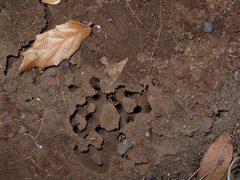
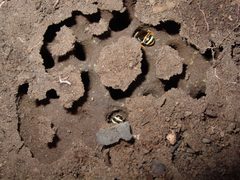
Nomia angustitibialis is a of ground-nesting in the Halictidae, described by Ribble in 1965. The species is known from Middle America and North America. As a member of the Nomia, it shares the group's characteristic nesting in soil, though specific details of its remain poorly documented compared to the well-studied Nomia melanderi.
Pronunciation
How to pronounce Nomia angustitibialis: //ˈnoʊ.mi.ə æŋˌɡʌs.tɪˈtɪb.iˌæl.ɪs//
These audio files are automatically generated. While they are not always 100% accurate, they are a good starting point.
Identification
Nomia angustitibialis can be distinguished from by its narrow tibiae, as indicated by the specific epithet 'angustitibialis' (Latin: narrow tibia). Detailed diagnostic features distinguishing it from other Nomia require examination of morphological characters not fully described in available sources.
Images
Distribution
Middle America and North America. Distribution records indicate presence in both regions, though specific countries or localities are not documented in available sources.
Similar Taxa
- Nomia melanderiBoth are ground-nesting bees in the Nomia, but N. melanderi is distinguished by its intensively managed in agricultural settings and its role as a commercial alfalfa , whereas N. angustitibialis lacks documented agricultural use.
- Nomia nevadensisShares the Nomia and ground-nesting habit, but differs in distribution and specific morphological characters; N. angustitibialis is distinguished by its narrow tibiae.
More Details
Taxonomic note
The epithet 'angustitibialis' refers to the narrow tibiae, a morphological character used in its original description by Ribble (1965). The Nomia belongs to the Nomiinae within Halictidae, a group of bees often called 'alkali bees' due to their association with saline or alkaline soils in some species.
Data availability
Nomia angustitibialis is notably data-deficient compared to N. melanderi, which has been extensively studied due to its economic importance in alfalfa pollination. Only two iNaturalist observations were recorded as of the source date, suggesting it may be genuinely rare, under-collected, or restricted to specific not frequently surveyed.