
Dieunomia nevadensis bakeri
(Cockerell, 1898)
Baker's Nomia
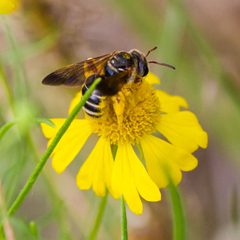
Baker's Nomia is a of the Nevada nomia, a sweat bee in the Halictidae. It was described by Cockerell in 1898 and is distinguished from the nominate subspecies by morphological characteristics. The subspecies occurs in western North America, where it is associated with alkali and saline . Like other Dieunomia , it is a ground-nesting with specialized ecological requirements.
Pronunciation
How to pronounce Dieunomia nevadensis bakeri: /diːjuːˈnoʊmiə nəˌvɑːˈdɛnsɪs ˈbeɪkərɪ/
These audio files are automatically generated. While they are not always 100% accurate, they are a good starting point.
Identification
Distinguished from Dieunomia nevadensis nevadensis by subtle morphological differences in and coloration, though specific diagnostic characters require examination of . Females can be recognized by the combination of large size, dense pale pubescence on the , and the distinctive flattened hind tibia with a scopa adapted for pollen transport. Males have modified hind legs with dense fringes of hair. Separation from other Dieunomia requires detailed examination of genitalic and wing venation characters.
Images
Habitat
Alkaline and saline environments including salt flats, alkali meadows, and seepage areas in arid and semi-arid regions. Often found in association with salt-tolerant vegetation.
Distribution
Western North America, including parts of the Great Basin and adjacent regions. The subspecific distribution is more restricted than the as a whole, which ranges from Central America through North America.
Seasonality
are active during the warm season, with peak activity in summer months when plants are in bloom.
Behavior
Ground-nesting solitary . Females excavate burrows in alkaline soils, often in . Visits flowers for nectar and pollen, with observed associations with Asteraceae and other . Males patrol nesting areas seeking females.
Ecological Role
in saline and alkaline . Contributes to of salt-tolerant flowering plants in where few other occur.
Similar Taxa
- Dieunomia nevadensis nevadensisNominate ; differs in distribution and subtle morphological characters including details of and coloration
- Dieunomia heteropodaOverlapping distribution; distinguished by hind leg and male genitalic characters
- Dieunomia trianguliferaSimilar size and preference; separated by facial markings and wing venation