
Dieunomia nevadensis
(Cresson, 1874)
Nevada nomia
Species Guides
3- Dieunomia nevadensis angelesia(Nevada nomia)
- Dieunomia nevadensis arizonensis(Arizona Nomia)
- Dieunomia nevadensis bakeri(Baker's Nomia)
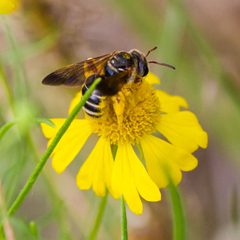
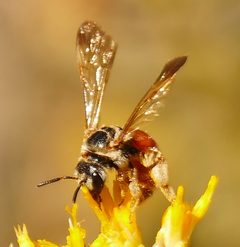
Dieunomia nevadensis, commonly known as the Nevada nomia, is a of sweat bee in the Halictidae. First described by Ezra Cresson in 1874, this occurs across Central America and North America. The species includes five recognized that vary in coloration, size, and geographic range. Subspecies exhibit notable morphological differences, with some forms distinguished by abdominal coloration ranging from red to black.

Pronunciation
How to pronounce Dieunomia nevadensis: /diː.juˈnoʊ.miə nɪ.vəˈdɛn.sɪs/
These audio files are automatically generated. While they are not always 100% accurate, they are a good starting point.
Identification
The D. n. arizonensis is distinguished by an extensively red . D. n. bakeri is approximately 2 mm longer and more robust than typical D. nevadensis, with a black rather than yellowish-red abdomen, coarser punctures in the , and less red . D. n. bakeri was originally described as a separate but subordinated based on identical genitalia despite outward differences.
Images
Distribution
Occurs in Central America and North America. The D. n. arizonensis is found in the southwestern and western United States and Mexico. D. n. bakeri ranges eastward to Texas, Florida, and North Carolina; westward to Colorado and Wyoming; and northward to Illinois, with range overlap with D. n. arizonensis.
More Details
Subspecies
Five are recognized: D. n. angelesia (Cockerell, 1910), D. n. arizonensis (Cockerell, 1899), D. n. bakeri (Cockerell, 1898), D. n. nevadensis (Cresson, 1874), and D. n. stellata (Cross, 1958). D. n. bakeri was synonymized in 1930 based on genital despite distinct external appearance.
Sources and further reading
- BugGuide
- Wikipedia
- GBIF taxonomy match
- iNaturalist taxon
- NCBI Taxonomy
- Catalogue of Life
- Grasshoppers of Colorado
- Grasshoppers of Colorado
- Species Records and Accounts
- Rising from the Ashes--Some Day | Bug Squad
- Let’s make a deal! | Beetles In The Bush
- New Study Helps California's Bumble Bees by Identifying Their Favorite Flowers