
Augochlorella
Sandhouse, 1937
sweat bees
Species Guides
4- Augochlorella aurata(golden green sweat bee)
- Augochlorella neglectula(sweat bee)
- Augochlorella nigrocyanea
- Augochlorella pomoniella(Peridot Sweat Bee)
Augochlorella is a of small, metallic sweat bees in the Halictidae. Members are distinguished from related genera by microscopic wing venation and structure. The genus exhibits flexible sociality, with some forming eusocial colonies while others remain solitary depending on environmental conditions. Augochlorella aurata is among the most common bees in eastern North America and serves as an important of wildflowers and agricultural crops.
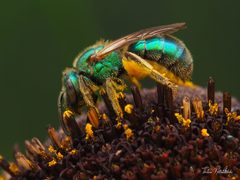
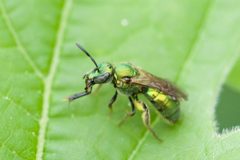
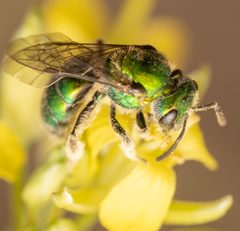
Pronunciation
How to pronounce Augochlorella: //ˌɔː.ɡoʊ.kloʊˈrɛl.lə//
These audio files are automatically generated. While they are not always 100% accurate, they are a good starting point.
Identification
Distinguished from the closely related Augochlora by three microscopic characters: pointed (not squared) tip of the marginal , orthogonal (not oblique) epistomal , and absence of a strong basal lobe on the inner metatibial spur. Externally, Augochlorella are virtually identical to Augochlora and Augochloropsis; definitive identification to genus requires specimen examination under a microscope.
Images
Habitat
Nests constructed in underground burrows in well-drained soils, typically in flat or sloped bare ground. Found in fields and wooded locations across a wide variety of . Nest burrows range 5–25 cm deep depending on soil moisture. Augochlorella aurata has been documented in longleaf pine savannas, where it responds positively to prescribed fire regimes that create open ground and increased floral resources.
Distribution
New World distribution from northern Argentina to southern Canada, with highest abundance in Neotropical regions. Only a few reach the temperate Nearctic; Augochlorella striata (synonym of A. aurata) occurs further north than any other member of tribe Augochlorini. Augochlorella aurata is one of the most common bees in eastern North America.
Seasonality
Augochlorella aurata active from April through September in parts of its range. Queens initiate nest construction mid-April, completing by early May. Pollen ball construction occurs from second week of May through mid-August. begin nest expansion mid-June.
Diet
. Documented floral visits include Apocynum cannabinum, Erigeron strigosus, Pycnanthemum tenuifolium, Solidago odora, Euthamia graminifolia, wild roses, goldenrod, dogbane, fleabane, and mountain mint. Augochlorella aurata is an important pollinator of stone fruits, pome fruits, alfalfa, sunflower, pepper, strawberry, tomato, and watermelon.
Life Cycle
Eusocial or solitary depending on and environmental conditions. Eusocial nests: foundress produces initial of 1–2 female , then switches to male-biased brood (though female-biased broods occur less commonly). Workers are mostly sterile and slightly smaller than queens. Brood average around 3 per female; maximum nest size approximately 12 cells. Mean offspring per nest: 14–15. Two-week period of inactivity typically follows first -laying bout. Some cells reused, though most are used only once.
Behavior
Flexible social organization determined by growing season length: more often solitary at high altitudes, high latitudes, or where growing season is shorter; more often social where growing season exceeds threshold duration. Maritime Canadian show reduced production duration, fewer per nest, and fewer reproductive individuals. Nest foundresses may produce mixtures of workers and reproductively capable offspring in response to local conditions. Augochlorella aurata and A. persimilis sometimes nest in mixed . Typical distance for A. aurata: 60–210 m.
Ecological Role
Important in natural and agricultural . Augochlorella aurata is among the most frequently observed bees in longleaf pine forest studies, responding positively to prescribed fire management. Wild increase in areas with available wildflowers and nesting . Serve as prey for generalist including birds, asilid flies, and spiders.
Human Relevance
Valuable for commercial fruit and vegetable farming including stone fruits, pome fruits, alfalfa, sunflower, pepper, strawberry, tomato, and watermelon. Important for maintaining healthy urban gardens and parks. Subject of research on fire management effects on pollinator . Sometimes mistaken for cuckoo wasps by observers due to metallic coloration.
Similar Taxa
- AugochloraExtremely similar metallic green appearance; distinguished microscopically by squared (not pointed) marginal tip, oblique epistomal , and presence of strong basal lobe on inner metatibial spur. Augochlora pura frequently brassy, coppery, or bronze rather than green.
- AugochloropsisVirtually identical external ; requires microscopic examination for definitive separation. All three in tribe Augochlorini (Augochlora, Augochlorella, Augochloropsis) are easily confused without specimen analysis.
- AgapostemonAlso metallic green Halictidae; males have banded black and yellow (not metallic), females often hairier. More widespread and easily recognized than Augochlorini .
- Cuckoo wasps (Chrysididae)Similar metallic coloration frequently causes misidentification. Distinguished by : cuckoo wasps seldom visit flowers, move with quick jerky motions, and lack pollen-collecting scopae on hind legs. Sweat bees are common on flowers, move more directly, and females carry pollen.
More Details
Parasites
Subject to cleptoparasitism by Sphecodes (including S. pimpinellae), Microsphecodes, and some Lasioglossum . Sphecodes females typically kill existing or larva before oviposition. Most other lay eggs on unfinished walls or through sealed cells; their larvae kill host offspring and consume stored provisions. Also hosts kleptoparasitic mite Laelaspoides ordwayae, which feeds on pollen in cells, reducing food available for developing bees.
Fire ecology
Augochlorella aurata benefit from prescribed fire in longleaf pine . Burned sites support 2.3 times more total and 2.1 times more than unburned sites. Abundance and diversity peak immediately post-fire and decline with time since burn. Fires maintain openings, reduce ground cover, and release soil nutrients, increasing floral resources. Below-ground nesting species like Augochlorella appear to benefit from increased bare soil access.
Sources and further reading
- BugGuide
- Wikipedia
- GBIF taxonomy match
- iNaturalist taxon
- NCBI Taxonomy
- Catalogue of Life
- Augochlorella aurata bee - Entomology Today
- Augochlorella sweat bee on Venus flytrap flower - Entomology Today
- Augochlorella Archives - Entomology Today
- Augochlorella aurata Archives - Entomology Today
- Bug Eric: Metallica
- Study Shows How Prescribed Burns Benefit Bees
- A review of the bee genus Augochlorella (Hymenoptera: Halictidae: Augochlorini)