
Augochlora pura
(Say, 1837)
Pure Green Sweat Bee, Pure Gold-Green Sweat Bee
Species Guides
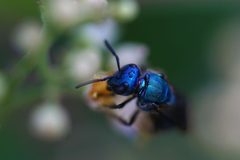
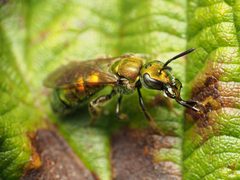
1A solitary sweat bee in the Halictidae, native to eastern North America. are typically 8 mm long with bright metallic green coloration, though Florida exhibit deep blue metallic coloration. The nests exclusively in rotting wood, utilizing pre-existing insect burrows to construct lined with a waxy secretion from the . Unlike many halictids, A. pura has secondarily lost social ; females are solitary nesters with no , though multiple females may aggregate during or when nesting near deceased mothers.

Pronunciation
How to pronounce Augochlora pura: /ɔːɡəˈklɔːrə ˈpjʊərə/
These audio files are automatically generated. While they are not always 100% accurate, they are a good starting point.
Identification
Distinguished from dull metallic green Lasioglossum (e.g., L. zephyrus) by bright, shiny coloration. Separated from cuckoo wasps ( Chrysididae) by presence on flowers, pollen collection on hind legs, and less jerky pattern. Distinguished from other Augochlorini (Augochlorella, Augochloropsis) by microscopic examination of morphological characters. Distinguished from Agapostemon by uniform metallic coloration (Agapostemon males have banded black and yellow ; most Agapostemon females have hairy, banded abdomens).
Images
Appearance
Small approximately 8 mm in length. Most exhibit bright, shiny metallic green coloration covering the entire body. Florida populations display deep blue metallic coloration (previously described as Augochlora pura mosieri). Males tend to have darker and may appear slightly more bluish than females. Both sexes possess pollen-collecting scopae on the hind legs (females only).
Habitat
Forest with rotting logs; also suburban wood piles. Nests constructed within xylem and phloem of fallen, decaying wood. Foraging occurs in nearby brush and pastures. Associated with passalid galleries in rotting wood.
Distribution
Eastern United States, ranging from Maine and Quebec west to Minnesota, south through Texas and Florida. Documented as far north as Quebec. Core range extends throughout deciduous forest regions of eastern North America.
Seasonality
Active from February through November, with longer seasons in southern states. season typically early April through September. Nests active from early May to early August. Females overwinter in ovarian from August through April.
Diet
floral visitor; has been observed foraging on over 40 distinct plant . Provisions with pollen and nectar collected from multiple flower species per cell. Both sexes observed licking human sweat, likely seeking sodium.
Host Associations
Life Cycle
Two to three per year in nature (up to six generations possible in laboratory conditions). Overwintered females emerge in April and found new nests. First emerges in June; daughters disperse to found their own nests rather than remaining as . Males emerge from first built, followed by females. Males die in fall; mated females enter ovarian beneath rotting logs until spring. No worker produced.
Behavior
Solitary nesting with no cooperative care. Females construct at night, forage for nectar and pollen in morning, and provision cells during afternoon. Males patrol fixed routes between flowers and sleep in groups of up to six when shelter is limited, all facing same direction. Males mate while visiting flowers, waiting for females to land rather than pursuing in . Copulation lasts approximately 28.5 seconds; males stroke female's with during mating. Aggressive nest defense against conspecifics, including offspring. Females aggregate during . Demonstrates cell recognition through odor of fresh pollen combined with cell shape and texture.
Ecological Role
of diverse flowering plants. Documented as in some southeastern U.S. bottomland hardwood forests (91% of bees collected in one study area). Contributes to decomposition system through utilization of rotting wood .
Human Relevance
Occasionally licks sweat from human skin, seeking salt; generally docile and reluctant to sting even when handled. Valued as native in gardens and natural areas. Used in mark-recapture studies to evaluate sampling methodology.
Similar Taxa
- Lasioglossum zephyrusDull metallic green coloration versus bright shiny green of A. pura
- Augochlorella aurataSocial with similar appearance; requires microscopic examination to distinguish
- Augochloropsis spp.Virtually identical appearance; microscopic examination required for separation
- Agapostemon spp.Males have banded ; females often hairier with abdominal banding
- Chrysididae (cuckoo wasps)Similar metallic coloration but lack pollen-collecting structures and are seldom found on flowers
More Details
Nest Architecture
Exhibits remarkable plasticity in nest construction, producing cluster nests (superimposed horizontal layers), platform nests (single plane), or tunnel nests (chainlike rows) depending on available space and resources. walls constructed from wood fragments coated with substrate and waxy secretion, possibly formed through -mediated polyesterification.
Neural Investment
Comparative study with social Augochlorella aurata demonstrates reduced relative mushroom body calyx volume in A. pura, consistent with social brain hypothesis predictions following loss of sociality.
Salt-seeking Behavior
Laboratory studies confirm strong attraction to NaCl solutions; elicited by sodium chloride exposure.
Sources and further reading
- BugGuide
- Wikipedia
- GBIF taxonomy match
- iNaturalist taxon
- NCBI Taxonomy
- Catalogue of Life
- Sweet and salty: Solitary sweat bee, Augochlora pura — Bug of the Week
- Bug Eric: Metallica
- Bugs in drawers: entomological outreach collections and their role in community engagement
- How Mark-Recapture Methods Can Validate Wild Bee Sampling Protocols
- Pure Gold-Green Sweat Bee Augochlora pura (Say 1837) (Insecta: Hymenoptera: Halictidae: Halictinae)
- Aggregation Behavior and Response to Sodium Chloride in Females of a Solitary Bee, Augochlora pura (Hymenoptera: Halictidae)
- The Loss of Sociality Is Accompanied by Reduced Neural Investment in Mushroom Body Volume in the Sweat Bee Augochlora Pura (Hymenoptera: Halictidae)