
Augochlora pura mosieri
Cockerell, 1922
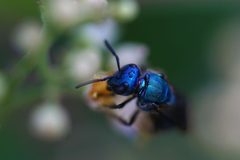
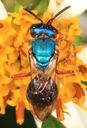
Augochlora pura mosieri is a of the solitary sweat bee Augochlora pura, described by Cockerell in 1922. As a member of the Halictidae , it exhibits the metallic green coloration typical of the Augochlorini tribe. Like other Augochlora pura , it is solitary, nesting in rotting wood galleries rather than soil. The subspecies designation indicates geographic variation within the broader range in eastern North America.
Pronunciation
How to pronounce Augochlora pura mosieri: /aʊˈɡɒklɔːrə ˈpjʊərə moʊˈzɪəri/
These audio files are automatically generated. While they are not always 100% accurate, they are a good starting point.
Identification
Cannot be reliably distinguished from other Augochlora pura or from Augochlorella and Augochloropsis by appearance alone; requires microscopic examination of morphological characters. Males lack pollen-collecting scopae on hind legs. Females carry pollen in brushes of hairs (scopae) on hind legs, distinguishing them from cuckoo wasps (Chrysididae) which do not collect pollen.
Images
Habitat
Associated with rotting wood for nesting; found in forested and semi-open where decaying wood and flowering plants are available.
Distribution
Eastern North America; exact range of this relative to nominate A. p. pura is not specified in available sources.
Seasonality
Active in summer; observed in mark-recapture studies during July-August 2020 in North Carolina.
Diet
feed on nectar from flowers; larvae provisioned with pollen and nectar. Adults have been observed collecting sweat from humans for salt, with NaCl solutions demonstrated to be highly attractive.
Life Cycle
Solitary nesting in galleries in rotting wood (including pre-existing insect galleries). Female constructs within galleries, provisions each with pollen and nectar balls, lays single per cell. Larvae consume provisions, pupate within cells, and emerge as . No ; each female independently provisions her own offspring.
Behavior
Solitary nesting . Females forage for pollen and nectar to provision offspring. occasionally lap sweat from human skin to obtain salts. Docile and reluctant to sting; defensive stinging requires prolonged provocation. Males perch on vegetation to watch for females.
Ecological Role
of flowering plants; has been recorded visiting more than 40 different plant . Contributes to pollination services in natural and garden .
Human Relevance
Occasionally visits humans to collect sweat salts; poses minimal sting risk due to solitary nature and docile temperament. Subject of mark-recapture studies evaluating sampling methodologies.
Similar Taxa
- Augochlorella spp.Virtually identical metallic green appearance; microscopic examination required for separation.
- Augochloropsis spp.Virtually identical metallic green appearance; microscopic examination required for separation.
- Agapostemon spp.Similar metallic green coloration; males of Agapostemon have banded black and yellow rather than metallic coloration, and females often have distinct hair banding patterns.
- Chrysididae (cuckoo wasps)Similar metallic coloration; distinguished by (seldom on flowers, quick jerky movements), lack of pollen-collecting structures, and -like body form.
More Details
Taxonomic Status
Recognized as a valid by Catalogue of Life, though detailed diagnostic features distinguishing it from nominate A. p. pura are not provided in available sources.
Research Significance
Included in mark-recapture studies validating sampling protocols, demonstrating that aerial netting better reflects abundance than pan traps for this .
Sources and further reading
- BugGuide
- iNaturalist taxon
- NCBI Taxonomy
- Catalogue of Life
- Sweet and salty: Solitary sweat bee, Augochlora pura — Bug of the Week
- Bug Eric: Metallica
- Bugs in drawers: entomological outreach collections and their role in community engagement
- How Mark-Recapture Methods Can Validate Wild Bee Sampling Protocols