
Augochlorella aurata
(Smith, 1853)
golden green sweat bee, golden sweat bee
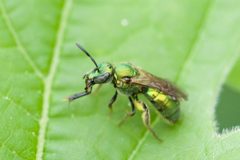
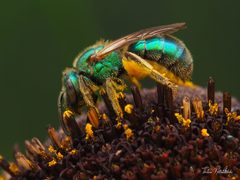
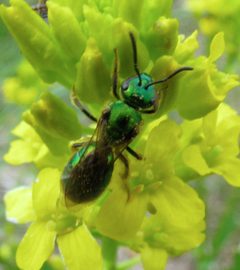
Augochlorella aurata is a primitively eusocial sweat bee (Halictidae) and one of the most common bees in eastern North America. display brilliant metallic green coloration, often diffused with , red, or yellow tones. The nests in soil and exhibits a seasonal colony cycle with distinct foundress, , and reproductive phases. It is a pollen forager and has been documented visiting numerous horticultural crops and native plants.
Pronunciation
How to pronounce Augochlorella aurata: /ˌɔːɡoʊˈklɔːrɛlə ɔːˈreɪtə/
These audio files are automatically generated. While they are not always 100% accurate, they are a good starting point.
Identification
Distinguished from Augochlora pura by rounded (not forked) tip and pointed (not squared) forewing marginal . Separated from Agapostemon by smooth, ridgeless propodeum. Distinguished from Augochloropsis by simple or only slightly serrated hind tibial spur (Augochloropsis has strongly serrated or pectinate spur). Distinguished from cuckoo wasps by presence on flowers, pollen collection , and less erratic pattern.
Images
Habitat
Ground-nesting found in diverse open including longleaf pine savannas, meadows, forest edges, and agricultural areas. Thrives in recently burned habitats where fire maintains openings and promotes floral resources. Nests excavated in soil, often with small tumulus of excavated earth at entrance.
Distribution
Eastern and central North America, from southern Canada (Ontario, Quebec) south to Florida and west to Colorado and Texas. Sparse records from California and South America. Northernmost representative of primarily Neotropical tribe Augochlorini.
Seasonality
Active from spring through fall. Colony cycle begins in spring with foundress and nest establishment; phase in early summer; reproductive phase late summer; mating in early fall; as inseminated females.
Diet
Polylectic pollen forager; collects pollen from diverse plant . Documented visiting tomato, Echinacea, strawberry, apple, blueberry, cantaloupe, coffee, cranberry, pepper, and watermelon.
Life Cycle
Primitively eusocial with colony cycle: (1) Foundress phase—overwintered female establishes nest and provisions first of males and females; (2) phase—first brood females emerge as non-reproductive workers, foundress becomes and ceases foraging; (3) Reproductive phase—workers assist queen in raising second brood of reproductives; (4) Mating and —second brood mates, females overwinter to become next year's foundresses. Average nest produces 14–15 offspring. Some individuals may skip worker phase or remain solitary.
Behavior
Females excavate soil nests and collect pollen using scopal hairs on hind legs. Males perch on vegetation to seek females. Colony members may exhibit guarding at nest entrance. Frequently observed on flowers; attracted to salt in human sweat.
Ecological Role
Important in eastern North American ; likely significant pollinator of horticultural crops. Contributes to pollination networks in fire-maintained such as longleaf pine savannas. Below-ground nesting activity may influence soil structure and nutrient cycling.
Human Relevance
Valued of commercially important crops including tomato, strawberry, blueberry, and other fruits. "sweat bee" reflects attraction to human perspiration; stings are mild and rare. Subject of ecological research on fire management effects on pollinator .
Similar Taxa
- Augochlora puraSimilar metallic green appearance; distinguished by forked tip and squared forewing marginal
- Augochloropsis spp.Similar size and coloration; distinguished by strongly serrated or pectinate hind tibial spur
- Agapostemon spp.Similar metallic green coloration; distinguished by ridged propodeum and often banded in males
- Chrysididae (cuckoo wasps)Nearly identical metallic appearance; distinguished by absence of pollen collection, erratic , and lack of floral visitation
Sources and further reading
- BugGuide
- Wikipedia
- GBIF taxonomy match
- iNaturalist taxon
- NCBI Taxonomy
- Catalogue of Life
- Bembicid Holdings | Entomology Research Museum
- Augochlorella aurata bee - Entomology Today
- Study Shows How Prescribed Burns Benefit Bees
- Bug Eric: Metallica
- For Insect Ecologists, Some Rare Species Interactions Are a Sign of Things to Come
- How Mark-Recapture Methods Can Validate Wild Bee Sampling Protocols
- A review of the bee genus Augochlorella (Hymenoptera: Halictidae: Augochlorini)