
Discothyrea
Roger, 1863
Species Guides
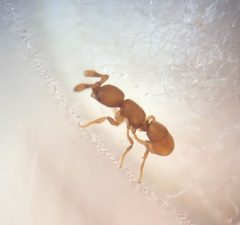
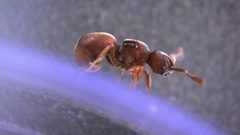
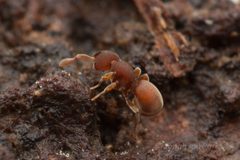
1Discothyrea is a of small, cryptic ants in the Proceratiinae, distributed across tropical and subtropical regions worldwide. These ants are rarely encountered due to their inconspicuous habits and small colony sizes. They are of , particularly spider and eggs, and have been observed storing eggs in their nests. The genus has been taxonomically neglected due to poor representation in museum collections, though recent revisions using X-ray microtomography and 3D cybertaxonomy have significantly advanced knowledge, particularly for Afrotropical .
Pronunciation
How to pronounce Discothyrea: //ˌdɪskoʊˈθɪəriə//
These audio files are automatically generated. While they are not always 100% accurate, they are a good starting point.
Identification
Discothyrea can be distinguished from other proceratiine ants by their extremely small size ( 0.2–0.5 mm), cryptic habits, and specialized . Recent revisions have established two in the Afrotropics: the D. oculata complex and the D. traegaordhi complex. Identification relies on detailed examination of cephalic structures, for which 3D cybertaxonomy based on micro-CT data provides superior resolution compared to traditional methods. The is most readily separated from similar small cryptic ants by its combination of proceratiine affinities, minute size, and oophagous .
Images
Habitat
Nests occur in rotten wood, leaf litter interstices, and under stones. In the Atlantic Forest of Brazil, D. sexarticulata has been found in homogeneous landscapes with anthropogenic influence (0–68% urban, 0–51% rural), while D. neotropica occurs only in heterogeneous landscapes with 74–95% native vegetation. The is strongly associated with preserved native vegetation and .
Distribution
Tropical and subtropical regions worldwide. In the Neotropics, recorded from the midwestern and southeastern United States to northern Argentina, including Atlantic Forest sites in São Paulo state, Brazil. Afrotropical fauna includes 20 recognized . The southernmost record is D. neotropica from southeastern Buenos Aires province, Argentina. Two fossil species, D. gigas and D. maya, are known from Dominican and Mexican amber.
Diet
feeding almost exclusively on , particularly those of spiders and . have been observed storing eggs in nests. Tenebrio molitor larvae have also been recorded as prey.
Life Cycle
Colonies contain few individuals. Queens are known but detailed reproductive remains poorly documented.
Behavior
Cryptic and inconspicuous habits; rarely detected in standard litter . Nests are small and hidden in interstices. store in nests. D. sexarticulata shows to anthropogenic landscape modification, while D. neotropica is more sensitive to disturbance.
Ecological Role
Important component of fauna in tropical and subtropical forests. As a of , Discothyrea contributes to control of spiders and . The serves as an indicator of quality, with showing differential sensitivity to landscape modification.
Human Relevance
Subject of recent cybertaxonomic research demonstrating advanced imaging techniques. The 2019 revision of Afrotropical Discothyrea established a model for 3D cybertaxonomy in entomology, with complete datasets (micro-CT data, 3D models, videos) available as open-access cybertypes.
Similar Taxa
- ProceratiumAlso in Proceratiinae with similar cryptic habits and - , but Proceratium are generally larger and more frequently collected.
- LeptanillinaeSimilarly obscure ants with small colonies and specialized habits, but Leptanillinae are subterranean with reduced and distinct morphological adaptations for hypogaeic life.
- StrumigenysSmall cryptic ants often found in similar leaf litter , but Strumigenys (Myrmicinae) have distinctive elongate for on Collembola and other small arthropods rather than oophagy.
More Details
Cybertaxonomy and Open Science
The 2019 revision of Afrotropical Discothyrea by Lieberman, Hita-Garcia, and colleagues represents a landmark in , describing 15 new and establishing 3D cybertaxonomy protocols. All micro-CT data, 3D surface models, and videos are available as open-access cybertype datasets (Dryad repository), enabling virtual examination of specimens without physical access.
Fossil Record
Two fossil are known: D. gigas from Dominican amber and D. maya from Mexican amber, providing evidence for the long evolutionary history of this in the New World tropics.
Sources and further reading
- BugGuide
- Wikipedia
- GBIF taxonomy match
- iNaturalist taxon
- NCBI Taxonomy
- Catalogue of Life
- News Flash: Don't Miss 'Current Techniques in Morphology' | Bug Squad
- Let's All Appreciate Ants! Don't Miss These Biodiversity Museum Programs | Bug Squad
- Something 'Bugging' You? Ask the Bug Doctors | Bug Squad
- What do different landscapes of the Atlantic Forest reveal about the occurrence of Discothyrea Roger, 1863 (Formicidae: Proceratiinae)?
- New locality record of Discothyrea neotropica (Bruch, 1919) (Hymenoptera, Formicidae) for Argentina and remarks on its distribution
- New locality record of Discothyrea neotropica (Bruch, 1919) (Hymenoptera, Formicidae) for Argentina and remarks on its distribution
- Revision of the Highly Specialized Ant Genus Discothyrea (Hymenoptera: Formicidae) in the Afrotropics with X-Ray Microtomography and 3D Cybertaxonomy
- New locality record of Discothyrea neotropica (Bruch, 1919) (Hymenoptera, Formicidae) for Argentina and remarks on its distribution