
Strumigenys
Smith, 1860
Mustache and Pygmy Snapping Ants
Species Guides
19- Strumigenys ananeotes
- Strumigenys arizonica(Arizona Mustache Ant)
- Strumigenys chiricahua
- Strumigenys clypeata
- Strumigenys dietrichi(Dietrich's Mustache Ant)
- Strumigenys eggersi(Eggers' Pygmy Snapping Ant)
- Strumigenys hexamera
- Strumigenys louisianae(louisianae-group Pygmy Snapping Ants)
- Strumigenys membranifera(Bare Mustache Ant)
Strumigenys is a hyperdiverse of small predatory ants in the Myrmicinae, comprising over 880 . Members are characterized by specialized ranging from gripping to trap-jaw mechanisms, and cryptic lifestyles primarily in leaf litter and soil . The genus exhibits remarkable diversity in nesting strategies, including solitary nesting, xenobiosis, and social . Several species reproduce via , a rare trait among ants that facilitates of new environments.
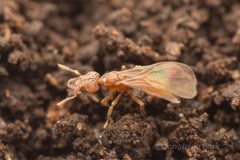
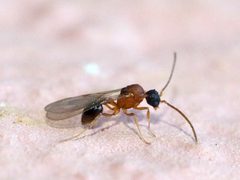
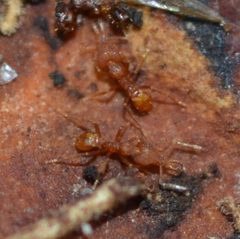
Pronunciation
How to pronounce Strumigenys: /strʊmaɪˈdʒɛnɪs/
These audio files are automatically generated. While they are not always 100% accurate, they are a good starting point.
Identification
Distinguished from other Myrmicinae by the combination of spongiform tissue on metasoma (in most ), highly modified setae, and reduced antennal and palp segmentation. Convergent presence of spongiform tissue occurs in Dacetinops and Tetheamyrma, requiring examination of mandibular and setal characters for definitive identification. Species-level identification relies heavily on and pilosity patterns.
Images
Habitat
Predominantly leaf litter and soil ; nests commonly in soil, under rocks, in or under dead wood and logs, under bark, or among epiphytes. Some forage arboreally. Occurs across diverse habitats from tropical rainforests to Mediterranean and temperate climates.
Distribution
Pantropical with greatest diversity in tropical rainforests worldwide; extends into temperate regions. Documented regional diversity includes: Afrotropical (139 ), Australasian (60), Indo-Australian (258), Malagasy (94), Nearctic (59), Neotropical (214), Oriental (97), and Palearctic (81).
Diet
of small arthropods, with springtails (Collembola) as the most common documented prey. Some occasionally feed on sugar sources such as extrafloral . Strumigenys thaxteri has been observed capturing larger flying insects through sit-and-wait ambush on vegetation.
Host Associations
- Platythyrea conradti - xenobiosis/mutualismStrumigenys maynei lives in nests, preys on arthropods within nest, may defend nest against other ants
- Trachymyrmex arizonensis - obligate inquilinism/mutualism or commensalismStrumigenys arizonica obligately nests within fungus-farming nests, feeds on springtails within nests
- Aphaenogaster, Camponotus, Formica - facultative xenobiosisStrumigenys pergandei often found in nests of larger ants but also nests independently
- Strumigenys loriae - Strumigenys yaleogyna lives in nest; forage and hunt but with reduced ability compared to host
- Strumigenys perplexa - workerless Strumigenys xenos produces no ; attractive to workers who tend and evacuate her
Life Cycle
Colony foundation varies: some reproduce sexually, while at least six species (S. hexamera, S. membranifera, S. rogeri, S. emmae, S. liukueiensis, S. solifontis) are known to reproduce via , producing female offspring without . Queens in thelytokous species retain functional spermathecae, potentially allowing rare mating events to increase genetic variability.
Behavior
Most forage solitarily for small prey among organic debris. Some species exhibit sit-and-wait ambush on vegetation. Multiple species engage in symbiotic relationships with other ants ranging from mutualism to social . Trap-jaw species use rapid closure to capture prey.
Ecological Role
of small soil and litter arthropods, particularly springtails. Contributes to nutrient cycling and in leaf litter . In tropical regions, often an abundant component of litter fauna.
Human Relevance
Several are known tramp species spread via human commerce, establishing in artificially heated greenhouses and other human-modified environments. Thelytokous in these species facilitates of new areas. Some populations may be introduced rather than native, though genetic analyses are needed to confirm status in many cases.
Similar Taxa
- Dacetinops of spongiform tissue; distinguished by different mandibular and setal characters
- Tetheamyrma of spongiform tissue; phylogenetically unrelated with similar cuticular modifications
- PyramicaFormerly recognized as separate based on and ; now synonymized with Strumigenys following molecular phylogenetic analysis
More Details
Taxonomic History
The has accumulated 28 generic synonyms since its establishment in 1860. Pyramica was the most notable synonym, moved in and out of synonymy multiple times based on and before molecular supported synonymy with Strumigenys.
Gender-Inclusive Nomenclature
Strumigenys ayersthey was described in 2021 with the suffix -they, representing one of the first names explicitly recognizing non-binary gender identity, honoring artist and activist Jeremy Ayers.
Mandible Evolution
Short-trap and long-trap forms have evolved independently multiple times from gripping ancestral forms, with transitions also documented between trap-jaw types, representing a striking example of convergent and reversible morphological evolution.
Sources and further reading
- BugGuide
- Wikipedia
- GBIF taxonomy match
- iNaturalist taxon
- NCBI Taxonomy
- Catalogue of Life
- New ant species named in recognition of gender diversity | Blog
- Top 10 new species of 2021 from Pensoft journals, Part 2
- Geographic Distributions ofStrumigenys gundlachiandStrumigenys eggersi(Hymenoptera, Formicidae)
- Taxonomy and Natural History of Strumigenys thaxteri Wheeler and Strumigenys reticeps (Kempf) (Hymenoptera: Formicidae)
- Geographic distribution of Strumigenys louisianae (Hymenoptera: Formicidae)
- Geographic Distribution of Strumigenys epinotalis (Hymenoptera: Formicidae)
- Parthenogenetic Reproduction in Strumigenys Ants: An Update
- First record of Strumigenys membranifera (Emery, 1869) (Hymenoptera, Formicidae) from Crete and Strumigenys baudueri (Emery, 1875) from Andros in Greece
- Strumigenys emmae (Emery, 1890) (Myrmicinae) new to Britain, with an updated key to the known Strumigenys of the West Palaearctic
- A revision of the rare Strumigenys mnemosyne (Formicidae; Myrmicinae) group using micro-CT scanning, with the description of three new species, and the virtual repair of a broken paratype.