
Strumigenys rogeri
Emery, 1890
Roger's Pygmy Snapping Ant
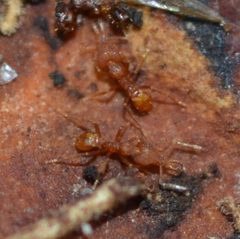
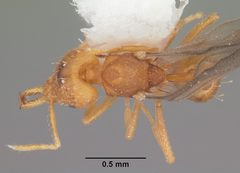
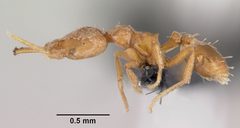
Strumigenys rogeri is a small dacetine first described by Emery in 1890. It is notable for exhibiting in Taiwan, where virgin queens produce female offspring without mating. This reproductive mode, combined with a short development time of approximately 39 days, may contribute to its success as a tramp ant species. The species belongs to a of over 850 species characterized by distinctive trap-jaw .
Pronunciation
How to pronounce Strumigenys rogeri: /ˌstruːmɪˈdʒɛnɪs roʊˈdʒɛraɪ/
These audio files are automatically generated. While they are not always 100% accurate, they are a good starting point.
Images
Distribution
Taiwan; also recorded from Aguas Claras, Alejandría, Colindres, El Medio, San Julián (likely Rica), Brazil (Bahia), Barbados, and Belgium (doubtful record).
Life Cycle
Development from to or in approximately 39 days under laboratory conditions.
Human Relevance
Considered an tramp ant in Taiwan, with potential characteristics facilitated by parthenogenetic .
More Details
Reproductive Biology
has been confirmed in Taiwan through laboratory experiments. Virgin queens produced both and young queens from unfertilized . Workers are strictly sterile, lacking a spermatheca. No males have been observed in field colonies.
Nomenclature Note
The specific epithet 'rogeri' follows traditional Latinized naming conventions, using the -i suffix for male honorific names.
Sources and further reading
- BugGuide
- GBIF taxonomy match
- iNaturalist taxon
- NCBI Taxonomy
- Catalogue of Life
- New ant species named in recognition of gender diversity | Blog
- Top 10 new species of 2021 from Pensoft journals, Part 2
- Thelytokous parthenogenesis in the exotic dacetine ant Strumigenys rogeri (Hymenoptera: Formicidae) in Taiwan