
Trachymyrmex arizonensis
(Wheeler, 1907)
Arizona Fungus-farming Ant
Trachymyrmex arizonensis is a higher-attine fungus-growing native to the southwestern United States and Mexico. The cultivates symbiotic fungi as its primary food source, showing strong partner fidelity with its fungal cultivar lineage. Phylogenetic studies reveal a pattern of 'one-to-one with some exceptions' in its ant-fungal specificity, with high fidelity to its own fungal subclade and rare instances of horizontal fungal transfer between colonies. Males exhibit distinctive with reduced size relative to body, a trait shared with other attine ants.
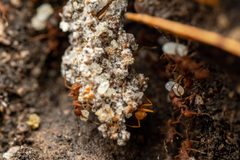
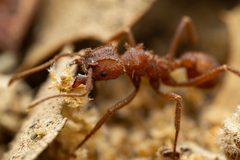
Pronunciation
How to pronounce Trachymyrmex arizonensis: /ˌtrækɪˈmɜrmɛks ˌærɪzoʊˈnɛnsɪs/
These audio files are automatically generated. While they are not always 100% accurate, they are a good starting point.
Identification
Males can be distinguished from females by their disproportionately small relative to their large bodies, a trait noted in comparative studies of attine . This 'pin-headed' male morphology contrasts with the more proportional head-to-body ratio seen in females. Specific diagnostic features for identification are not documented in available sources.
Images
Distribution
Native to Arizona and adjacent regions of the southwestern United States and Mexico. Specific range boundaries are not precisely documented in available sources.
Diet
Cultivates symbiotic fungi as primary food source; specifically associated with Leucoagaricus gongylophorus or closely related fungal cultivars. The ants grow these fungi on prepared substrate of decomposed plant material.
Host Associations
- Leucoagaricus gongylophorus - mutualistic fungal cultivarPrimary fungal ; from parent to offspring colonies with rare horizontal transfer events
Life Cycle
Colony foundation involves of fungal cultivar from parent colony to new colony. Fungal are passed between through this vertical inheritance mechanism, though occasional horizontal transfer between colonies has been documented.
Behavior
Fungus includes substrate preparation, fungal garden maintenance, and of cultivars to daughter colonies. exhibit -repellent behaviors at nest sites, though specific nest defense behaviors for this are not documented. Males are known to have reduced behavioral repertoires compared to workers.
Ecological Role
Functions as a decomposer through processing of plant material into fungal substrate, contributing to nutrient cycling in arid . The mutualistic relationship with cultivated fungi represents a specialized form of external rumination that converts recalcitrant plant material into accessible nutrients.
Similar Taxa
- Trachymyrmex pomonaeSympatric congeneric in Arizona with which T. arizonensis has been directly compared in cophylogenetic studies; distinguished by and fungal cultivar associations rather than obvious morphological differences
- Atta and Acromyrmex leafcutter antsMore derived attine ants with which T. arizonensis shares the fungus-growing habit; T. arizonensis represents a more basal lineage with less specialized substrate processing and smaller colony sizes
More Details
Ant-fungal cophylogeny
-wide SNP analysis has challenged earlier conclusions about widespread fungal sharing in Trachymyrmex. While conventional suggested frequent horizontal transfer, high-resolution genomic data indicate that T. arizonensis exhibits strong fidelity to its own fungal subclade, with only rare documented cases of colonies growing fungi associated with different .
Male morphology
Males of T. arizonensis exemplify the 'big shoulders, tiny brains' pattern seen in many attine ants, with dramatically reduced size relative to body mass. This trait is shared with other higher attines including some Pheidole and Linepithema humile, though the evolutionary drivers of this dimorphism remain unexplained.
Sources and further reading
- BugGuide
- GBIF taxonomy match
- iNaturalist taxon
- NCBI Taxonomy
- Catalogue of Life
- Bug Eric: Wasp Wednesday: Polistes arizonensis
- Destination Sonoran Desert: A time to sting for the Giant Hairy Desert Scorpion, 'Hadrurus arizonensis' — Bug of the Week
- Bug Eric: A Spider Surprise
- Fire ant winged reproductives: male and female | Beetles In The Bush
- North America’s largest centipede | Beetles In The Bush
- COPHYLOGENETIC ANALYSES OF TRACHYMYRMEX ANT-FUNGAL SPECIFICITY: ‘ONE TO ONE WITH SOME EXCEPTIONS’