
Trachymyrmex
Forel, 1893
Species Guides
4- Trachymyrmex arizonensis(Arizona Fungus-farming Ant)
- Trachymyrmex nogalensis
- Trachymyrmex septentrionalis(Northern Fungus-farming Ant)
- Trachymyrmex smithi(Smith's Fungus-farming Ant)
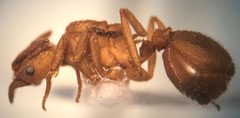
is a of fungus-growing ants in the Myrmicinae. The genus exhibits intermediate between leaf-cutter ants and non-cutter fungus-farming ants, using both fresh cut vegetation and detritus as substrate for their symbiotic fungal gardens. Most are tropical, distributed primarily in Central and South America, with nine species occurring in North America north of Mexico. The genus is currently , with recent molecular phylogenetic revisions moving 40 species to the new genera Mycetomoellerius and Paratrachymyrmex.
Pronunciation
How to pronounce Trachymyrmex: //ˌtrækɪˈmɜrmɛks//
These audio files are automatically generated. While they are not always 100% accurate, they are a good starting point.
Identification
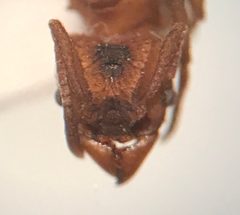
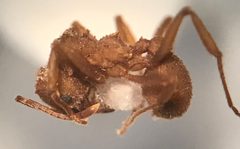
can be distinguished from the derived leaf-cutting Atta and Acromyrmex by their smaller size and less specialized mandibular . Males of Trachymyrmex exhibit distinctive with disproportionately small relative to their body size, a trait noted as characteristic of this genus. The genus is phylogenetically basal to the , sharing morphological features with both primitive and derived attine lineages. -level identification requires examination of morphology, with keys available for North American species based on worker, , and male characters.
Images
Habitat
occupy diverse including tropical forests, Brazilian restinga (coastal sandy plain vegetation), and temperate regions. septentrionalis in North America shows association with well-drained soils and sensitivity to water-table levels. Nest architecture varies seasonally and by species, with chambers constructed at depths ranging from 15 cm to over 200 cm depending on local soil conditions.
Distribution
Primarily tropical distribution with most in Central and South America. Nine species occur in North America north of Mexico: T. arizonensis, T. carinatus, T. desertorum, T. jamaicensis, T. nogalensis, T. pomonae, T. septentrionalis, T. smithi, and T. turrifex. T. septentrionalis ranges from Florida to Long Island, showing -level differences in demography across this latitudinal gradient.
Seasonality
holmgreni exhibits a seasonal colony cycle: investment in during autumn, new nest establishment in winter, and colony growth in spring and summer. occur at -specific times, with T. septentrionalis mating occurring at the end of the growing season.
Diet
Cultivates symbiotic fungus gardens as the primary food source. Uses both fresh cut vegetation and detritus as substrate for fungal , representing intermediate foraging between leaf-cutter and non-cutter attine ants. The specific fungal cultivar varies by , with evidence supporting high fidelity and codivergence between ant and fungal .
Host Associations
- Symbiotic fungus (Leucocoprineae) - mutualismEach cultivates specific fungal subclades with high fidelity; peptaibol compounds from competing Trichoderma fungi trigger ant weeding
- Trichoderma spp. - antagonistPathogenic fungi that invade gardens; detected by ants through peptaibol metabolite cues, inducing removal of compromised garden material
- Diapriidae wasps - Diverse of documented attacking T. cf. zeteki
Life Cycle
Colonies contain , queens, and males. Seasonal variation in colony demography includes autumn peaks in winged reproductives and spring peaks in individuals. Worker size distributions are unimodal and close to normal, with -specific variation in mean size and size variation. Colony size affects worker demography differently across populations: Florida colonies show increasing mean and standard deviation of worker width with colony size, while Long Island colonies show an inverse relationship independent of colony size.
Behavior
exhibit weeding to maintain fungus garden hygiene, physically removing garden pieces compromised by . This behavior is chemically mediated: peptaibol metabolites produced by Trichoderma fungi induce weeding responses that mirror reactions to live pathogens. Foraging activity is normally performed by workers, though atypical colonies have been observed where sexual females perform all foraging and colony maintenance when worker numbers are reduced. Nest architecture shows seasonal variation in chamber number and depth.
Ecological Role
Fungus-farming ants contribute to decomposition and nutrient cycling through of symbiotic fungi on plant material and detritus. As intermediate foragers between leaf-cutters and detritus-feeders, they process diverse organic substrates. septentrionalis has been described as extremely abundant in parts of its range, with abundance increasing during multiyear droughts due to sensitivity to soil moisture and water-table levels. Their ecological impact presumably with abundance during drought periods.
Similar Taxa
- MycetomoelleriusFormerly included in ; 31 moved to this new in 2019 based on molecular ; distinguished by genetic and presumably morphological characters not detailed in sources
- ParatrachymyrmexFormerly included in ; nine moved to this new in 2019 based on molecular
- AttaDerived with more specialized mandibular and larger size; is phylogenetically basal to Atta and uses less specialized foraging substrates
- AcromyrmexDerived with more specialized ; distinguished from by larger size and more elaborate cutting
More Details
Phylogenetic Status
The is currently . Solomon et al. (2019) moved 40 to new genera: 31 to Mycetomoellerius and 9 to Paratrachymyrmex, retaining only 9 species in Trachymyrmex. Further systematic revisions may be necessary based on additional genetic and morphological data.
Chemical Communication in Garden Maintenance
T. septentrionalis detects fungal garden through specific secondary metabolite cues. Peptaibols, a class of Trichoderma-derived compounds, induce weeding as a class rather than through single compounds. This represents an extended defense response where ants defend their mutualistic partner using chemical cues of .
Male Morphology
Males exhibit extreme with 'pin-headed' : disproportionately small and non-elbowed relative to body size. This pattern is considered derived within the attine ants and has evolved independently in several lineages including Pheidole, Linepithema, and .
Sources and further reading
- BugGuide
- Wikipedia
- GBIF taxonomy match
- iNaturalist taxon
- NCBI Taxonomy
- Catalogue of Life
- Fire ant winged reproductives: male and female | Beetles In The Bush
- Vicarious Friday Beetle Blogging | Beetles In The Bush
- Geographic Distribution ofTrachymyrmex jamaicensis(Hymenoptera: Formicidae)
- Nesting and distribution of Trachymyrmex holmgreni in Brazilian restinga
- The Adaptiveness of Worker Demography in the Attine Ant Trachymyrmex Septentrionalis
- Sexual castes of Trachymyrmex fuscus (Formicidae: Attini) performing worker tasks
- Foraging Behavior of Trachymyrmex turrifex Wheeler (Formicidae: Attini)
- COPHYLOGENETIC ANALYSES OF TRACHYMYRMEX ANT-FUNGAL SPECIFICITY: ‘ONE TO ONE WITH SOME EXCEPTIONS’
- A review of the North American species of the fungus-gardening ant genus Trachymyrmex (Hymenoptera: Formicidae)
- External and internal architecture of nests of fungus-growing ants of the genera Cyphomyrmex, Mycetarotes, Mycocepurus, Myrmicocrypta, and Trachymyrmex (Hymenoptera: Formicidae)
- Distribution of the fungus‐gardening ant ( Trachymyrmex septentrionalis ) during and after a record drought
- Biological notes on a fungus-growing ant, Trachymyrmex cf. zeteki (Hymenoptera, Formicidae, Attini) attacked by a diverse community of parasitoid wasps (Hymenoptera, Diapriidae)
- Trachymyrmex septentrionalis ants promote fungus garden hygiene using Trichoderma -derived metabolite cues
- Population-Based Cytogenetic Banding Analysis and Phylogenetic Relationships of the Neotropical Fungus-Farming Ant <b><i>Trachymyrmex holmgreni</i></b> Wheeler, 1925