
Ponera
Latreille, 1804
Porthole Ants
Species Guides
2- Ponera exotica(Southern Porthole Ant)
- Ponera pennsylvanica(Common Porthole Ant)
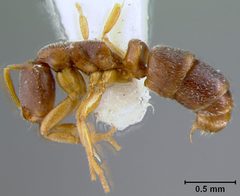
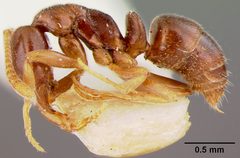
Ponera is a of small, soil-dwelling ponerine ants comprising over 60 extant worldwide. measure 1–4 mm in length. The genus is predominantly distributed across the Indomalaya and Australasia regions, with additional species in the Holarctic, Madagascar, and Japan. Nests typically contain fewer than 100 workers and are established in protected ground-level microhabitats including soil, cracks, rotten wood, bark, and moss on decaying logs. The etymology derives from the Ancient Greek *ponēra* (πονηρά, 'wicked, wretched'), Latinized as *Ponēra*.
Pronunciation
How to pronounce Ponera: /ˈpoʊnərə/
These audio files are automatically generated. While they are not always 100% accurate, they are a good starting point.
Identification
Ponera is most readily confused with the *Cryptopone*, *Hypoponera*, and *Pachycondyla*, requiring careful examination of mandibular structure, petiole , and pilosity patterns for definitive separation. -level identification often relies on subtle differences in mandibular tooth count, capsule proportions, and mesosomal sculpturing. The presence of four mandibular teeth distinguishes *Ponera tudigong* from all other .
Images
Appearance
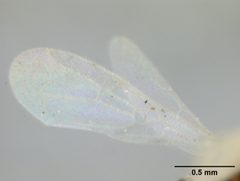
are very small to small, measuring 1–4 mm in body length. Queens are similar in to workers but possess wings. The exhibits reduced pigmentation and , consistent with its subterranean lifestyle. Some display distinctive mandibular ; for example, *Ponera tudigong* is unique within the genus for having four mandibular teeth.
Habitat
Endogeic and cryptobiotic, occupying protected ground-level microhabitats. Nests are established in soil, cracks in substrate, rotten wood, under bark, and moss covering decaying logs. Collections of *Ponera exotica* suggest a markedly patchy distribution consistent with subterranean existence.
Distribution
Predominantly Indomalaya and Australasia, with additional representation in the Holarctic region (including North America, where *Ponera exotica* is considered native), Madagascar (three : *P. petila*, *P. swezeyi*, *P. adumbrans*), Samoa, New Guinea, Australia, Japan, and Hong Kong.
Diet
Predatory. occurs in *Ponera coarctata*, involving exchange of alimentary liquid among colony members.
Life Cycle
Colonies are small, typically containing fewer than 100 . size variation in *Ponera coarctata* follows a normal distribution with isometric scaling, indicating a single queen morph despite pronounced size differences; size varies less within colonies than between colonies and appears colony-specific. Ovary length correlates with queen size.
Behavior
in orphaned colonies of *Ponera coarctata* interact aggressively at high frequency and rapidly establish following removal. occurs regularly in queenright colonies and increases in frequency following orphaning; food exchange appears to function as appeasement during aggressive interactions rather than solely for nutritional distribution.
Ecological Role
Small-colony, soil-dwelling occupying cryptic ground-level .
Similar Taxa
- CryptoponeSimilar small size, cryptobiotic habits, and reduced ; separation requires examination of mandibular and petiolar characters.
- HypoponeraOverlaps in size range and subterranean ; distinguished by details of mandibular and mesosomal structure.
- PachycondylaHistorically conflated with Ponera; differentiated by and nest architecture.
More Details
Taxonomic history
*Ponera yakushimensis* Tanaka was synonymized under *Ponera scabra* Wheeler based on morphological comparison of with material from Yakushima, Kyushu, and Honshu. *Ponera bableti* Perrault was synonymized under *Ponera petila* based on Linear Discriminant Analysis classification with probability = 1.
Biogeographic origins
The Malagasy Ponera fauna likely originated from Indo-Australian sources rather than African , as no native Ponera are known from the Afrotropical continent and closest exhibit almost exclusively Indo-Australian distributions.
Etymology
The generic name is the Latinized form (Ponēra) of the Ancient Greek ponēra (πονηρά), meaning 'wicked, wretched'.
Sources and further reading
- BugGuide
- Wikipedia
- iNaturalist taxon
- NCBI Taxonomy
- Catalogue of Life
- BIOGEOGRAPHY AND HABITATS OF PONERA EXOTICA (HYMENOPTERA: FORMICIDAE)
- Exploring the diversity of the Malagasy Ponera (Hymenoptera: Formicidae) fauna via integrative taxonomy
- Queen Size Variation in the Ponerine Ant Ponera coarctata (Hymenoptera: Formicidae)
- New synonym and new Japanese record of the ant genus Ponera (Hymenoptera: Formicidae)
- A new species and new record of the cryptobiotic ant genus Ponera Latreille, 1804 (Hymenoptera, Formicidae) from Hong Kong
- Trophallaxis and Aggression in the Ponerine Ant, Ponera coarctata: Implications for the Evolution of Liquid Food Exchange in the Hymenoptera
- New distribution records for Stenoponia americana (Baker) and Stenoponia ponera Traub and Johnson (Siphonaptera: Ctenophthalmidae) with a review of records from the Southwestern United States
- Morphology of External Genitalia in the Genus Acanthoponera Mayr, with Redescription of A. mucronata (Roger) Male (Hymenoptera: Formicidae: Ectatomminae).
- Revision of the Chinese species of the genus Brachyponera Emery, 1900 (Hymenoptera, Formicidae), with a key to the world species of the genus.