
Hypoponera punctatissima
(Roger, 1859)
Roger's ant
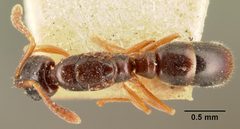
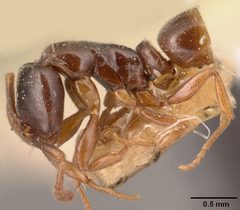
Hypoponera punctatissima, commonly known as Roger's , is a small ponerine ant native to Africa that has become a globally distributed tramp . The species is strongly associated with human-modified environments, particularly heated buildings, greenhouses, and animal waste. Colonies are small, typically containing approximately 200 , and are often polydomous. The species is frequently encountered through that appear above ground.
Pronunciation
How to pronounce Hypoponera punctatissima: //ˌhaɪ.poʊˈpoʊ.nɛ.rə ˌpʌŋk.təˈtɪs.ɪ.mə//
These audio files are automatically generated. While they are not always 100% accurate, they are a good starting point.
Identification
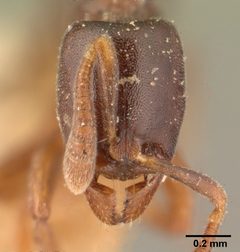
Distinguished from the closely related Hypoponera ergatandria by subtle morphological differences; the two were historically confused and many records of H. punctatissima in Europe are now considered doubtful and may refer to H. ergatandria. The single-segmented petiole places it in Ponerinae. The 12-segmented , triangular , and with elongated first two segments are key features. are the most commonly encountered form above ground.
Images
Habitat
In its native range: soil, rotting wood, gardens, and disturbed . In invaded temperate regions: restricted to heated buildings, greenhouses, manure and compost piles, and horse stables. Minimum temperature for colony establishment is approximately 21°C.
Distribution
Native to sub-Saharan Africa including Gulf of Guinea, Kenya, Uganda, Rwanda, Tanzania, Angola, Zambia, Mozambique, Botswana, South Africa, and north to Egypt, Sudan, Ethiopia, Central African Republic, and Democratic Republic of the Congo. or tramp distribution includes Western Europe (heated buildings only in northern and eastern regions), southern and western United States, Middle East, Yucatán Peninsula, Panama, Venezuela, New Zealand, northern Australia, New Guinea, Sri Lanka, Madagascar, Philippines, and scattered tropical regions. First recorded in Argentina in 2020.
Life Cycle
Colonies are polydomous with approximately 200 . involves (winged queens) that appear above ground and are the most likely form to be encountered. Ergatoid males present in two morphs; alate males apparently absent.
Behavior
Nests in diverse substrates depending on climate. In cooler regions, strongly associated with human structures and heated environments. Historical spread hypothesized to be facilitated by human use of horses as draft animals, with stables and providing suitable nesting .
Human Relevance
Considered a nuisance pest in heated buildings and greenhouses in temperate regions. queens can sting humans, though stings are not considered a public health threat. Frequently collected in horse stables in Great Britain. No known significant ecological or economic impact.
Similar Taxa
- Hypoponera ergatandriaHistorically confused with H. punctatissima; most European records previously attributed to H. punctatissima are now considered to refer to H. ergatandria. Both are tramp with similar colony size and general appearance.
Misconceptions
Many historical records of H. punctatissima, particularly in Europe, are now considered misidentifications of H. ergatandria. The true distribution of H. punctatissima outside its native range is less extensive than previously believed.
More Details
Historical dispersal hypothesis
The ' global distribution is hypothesized to have been facilitated by human use of horses as draft animals, with stable environments and providing suitable for colony establishment and transport.
Subspecies
Three recognized: H. p. punctatissima (nominate), H. p. indifferens, and H. p. jugata.
Sources and further reading
- BugGuide
- Wikipedia
- GBIF taxonomy match
- iNaturalist taxon
- NCBI Taxonomy
- Catalogue of Life
- Fire ant winged reproductives: male and female | Beetles In The Bush
- What’s the difference between a cricket and a grasshopper? - Buglife Blog - Buglife
- The ant fauna of El Impenetrable National Park: A preliminary survey with the first record of Hypoponera punctatissima in Argentina
- First Record of the Exotic Ant Hypoponera ergatandria in Italy: Indoor Alate Swarms and Stinging Queens