
Platythyrea punctata
(Smith, 1858)
Common Silvery Hunter Ant
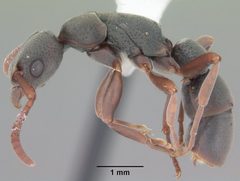
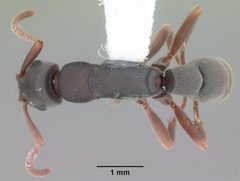
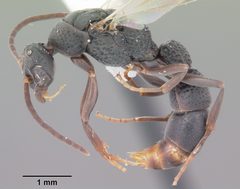
Platythyrea punctata is a neotropical distinguished by its remarkable reproductive flexibility. Most reproduce through , where unmated produce female offspring from unfertilized , resulting in colonies with clonal genetic structure. The species also exhibits facultative , with occasional queens, gamergates (mated reproductive workers), and males appearing in some populations. This combination of alternative reproductive tactics is unique among ants and has made the species a model for studying social evolution, division of labor, and the transition between sexual and .
Pronunciation
How to pronounce Platythyrea punctata: /ˌplætɪˈθaɪriə pʌŋkˈteɪtə/
These audio files are automatically generated. While they are not always 100% accurate, they are a good starting point.
Images
Distribution
Neotropical region. Documented from Florida (USA), Barbados, Puerto Rico, Rica, Brazil (Amazonas, Pará), and the Dominican Republic. show geographic variation in reproductive mode: queens absent from Barbados and Puerto Rico colonies but present in 29% of Florida colonies.
Life Cycle
exhibit delayed maturation of the and muscle fibers. Young workers remain within the nest during an intranidal period, during which the and thoracic muscle fibers thicken significantly. Final maturation occurs in forager individuals. Workers transitioning to outside tasks at younger ages show reduced longevity compared to those beginning to forage later in life.
Behavior
Colonies are primarily , with most activity during daylight hours and few observed outside nests at night. Workers display age-based : young individuals perform care and show higher levels of aggressive , while older workers spend more time outside the nest and . Brood care and aggression decrease with age. In queenless colonies, reproductive form through physical aggression and ritualized interactions, with typically one worker monopolizing despite multiple individuals potentially having developed ovaries. Policing behavior maintains reproductive suppression of subordinates by individuals.
More Details
Reproductive Biology
The exhibits three distinct reproductive morphs: queens ( and dealate), gamergates (mated reproductive ), and thelytokous parthenogenetic workers. Intercastes—individuals with intermediate between workers and queens—have been documented (66 individuals in 16 Florida colonies). In some Rican , uninseminated workers appear incapable of thelytokous , representing a geographic shift toward obligate .
Genetic Structure
Microsatellite analysis reveals extremely low intraspecific genetic variation and almost no differentiation within . Colonies typically show clonal structure with all nestmates sharing identical multilocus , reflecting the predominance of thelytoky combined with genetic bottlenecks and founder effects. Occasional colonies show genetic variability indicating , adoption of , or during .
Physiological Trade-offs
Reproductive status influences resource allocation: -laying individuals show reduced muscle fiber development compared to non-reproductive , suggesting metabolic costs are minimized in reproductives to support egg production. This demonstrates how eusociality alters selection pressures and results in temporal shifts in individual development to optimize colony-level resource allocation.
Sources and further reading
- BugGuide
- Wikipedia
- GBIF taxonomy match
- iNaturalist taxon
- NCBI Taxonomy
- Catalogue of Life
- Why bugs matter to me... - Buglife Blog - Buglife
- Wolbachia in Cockroaches: A New Paradigm for Urban Pest Management?
- Sand Prairie Conservation Area | Beetles In The Bush
- Policing and dominance behaviour in the parthenogenetic ant Platythyrea punctata
- Facultative sexual reproduction in the parthenogenetic ant Platythyrea punctata
- Colony structure and reproduction in the thelytokous parthenogenetic ant Platythyrea punctata (F. Smith) (Hymenoptera, Formicidae)
- Activity Patterns and Age-dependent Changes in Behavior in the Clonal Ant Platythyrea punctata
- Delayed maturation of the exoskeleton and muscle fibres in the ant Platythyrea punctata
- Microsatellites reveal clonal structure of populations of the thelytokous ant Platythyrea punctata (F. Smith) (Hymenoptera; Formicidae)