
Vollenhovia emeryi
Wheeler, 1906
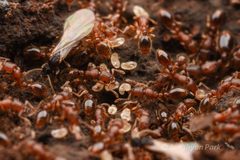
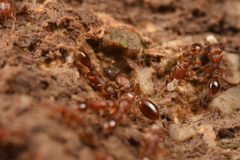
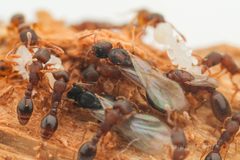
Vollenhovia emeryi is a -polymorphic notable for its unusual reproductive . The species produces two distinct queen morphs: long-winged (L) and short-winged (S) forms, which exhibit genetic differentiation and reproductive isolation. Both male and female sexuals are produced clonally, while arise sexually from fertilized —a reversal of the typical Hymenopteran pattern. The long-winged morph shows complete association with , while short-winged morphs lack this bacterial endosymbiont.
Pronunciation
How to pronounce Vollenhovia emeryi: //ˈvɔl.ənˌhoʊ.vi.ə ˈɛm.ə.ri.aɪ//
These audio files are automatically generated. While they are not always 100% accurate, they are a good starting point.
Identification
Distinguished from by the presence of two morphs differing in wing length: long-winged queens with fully developed wings and short-winged queens with reduced wings. Molecular phylogenetic analysis shows L- and S-queens from the same locality do not group together, indicating genetic divergence. The can be separated from V. nipponica, V. benzai, V. okinawana, and V. yambaru by mitochondrial markers; S-queens form a monophyletic clade derived from L-queen ancestors.
Images
Distribution
Documented from in Central Japan, Korea, and North America (conterminous 48 United States). The long-winged morph predominates in Korean populations, where the short-winged morph is rare.
Host Associations
- Wolbachia - endosymbiontAll long-winged queens infected; all short-winged queens lack . not required for clonal in this .
Similar Taxa
- Wasmannia auropunctataShares clonal male mechanism where males are produced from fertilized after exclusion of maternal nuclear ; represents of unusual reproductive strategy in Myrmicinae.
- Vollenhovia nipponica, V. benzai, V. okinawana, V. yambaruCongeneric used as outgroups in phylogenetic studies; V. emeryi distinguished by wing and associated pattern not reported in these relatives.
More Details
Queen polymorphism and reproductive isolation
Wing reduction has occurred once in the evolutionary history of this . The short-winged morph is derived from the long-winged morph and represents a genetically differentiated lineage, potentially leading to reproductive isolation and incipient speciation.
Genetic caste determination
Unlike most social Hymenoptera with environment-based differentiation, V. emeryi exhibits genetic differences between castes: queens are homozygous at microsatellite loci while are heterozygous, suggesting complex genetic underpinnings to caste fate.
Subspecies
Two recognized: Vollenhovia emeryi emeryi Wheeler, 1906 and Vollenhovia emeryi chosenica Wheeler, 1928.
Sources and further reading
- BugGuide
- Wikipedia
- GBIF taxonomy match
- iNaturalist taxon
- NCBI Taxonomy
- Catalogue of Life
- Clonal reproduction by males of the ant Vollenhovia emeryi (Wheeler)
- Association between host wing morphology polymorphism and Wolbachia infection in Vollenhovia emeryi (Hymenoptera: Myrmicinae)
- Clonal reproduction and genetic caste differences in a queen-polymorphic ant, Vollenhovia emeryi
- Association between host wing morphology polymorphism and Wolbachia infection in Vollenhovia emeryi (Hymenoptera: Myrmicinae)
- No gene flow between wing forms and clonal reproduction by males in the long-winged form of the ant Vollenhovia emeryi
- Phylogenetic Relationships among Populations ofVollenhoviaAnts, with Particular Focus on the Evolution of Wing Morphology