
Vollenhovia
Mayr, 1865
Species Guides
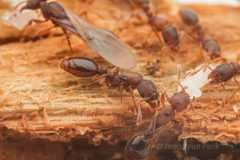
1Vollenhovia is a of myrmicine ants distributed primarily in the Australasian and Oriental regions, with notable diversity in India, Sri Lanka, and East Asia. The genus contains exhibiting remarkable reproductive strategies, including clonal by males (androgenesis) and in wing . At least one species, Vollenhovia nipponica, has evolved workerless social (inquilinism) on congeneric . The genus serves as an important model system for studying the evolution of unusual determination, sex determination systems, and reproductive isolation mechanisms.


Pronunciation
How to pronounce Vollenhovia: //ˌvɒl.ɛnˈhoʊ.vi.ə//
These audio files are automatically generated. While they are not always 100% accurate, they are a good starting point.
Identification
-level identification within Vollenhovia requires examination of qualitative and quantitative morphological characters. In the Indian subcontinent, eleven are recognized based on morphological revision, with four species to the Western Ghats biodiversity hotspot. (long-winged versus short-winged morphs) is present in some species and represents a key diagnostic feature for -level identification in V. emeryi. Comprehensive illustrated keys are available for regional faunas such as India and Sri Lanka.
Images
Distribution
Primarily distributed in the Australasian and Oriental regions. In the Indian subcontinent, the shows fragmentary known distribution requiring further sampling: four occur in the Western Ghats of Kerala, one is to Sri Lanka, three are known from Eastern India near the Bangladesh border, two from the Andaman and Nicobar Islands, and one from Himachal Pradesh in northern India. of V. emeryi have been studied in Korea, Japan, and North America.
Similar Taxa
- WasmanniaBoth exhibit male-mediated clonal (androgenesis) where males produce genetically identical sperm, representing of this rare reproductive strategy in Myrmicinae.
- MyrmicaBoth contain socially parasitic ; however, Vollenhovia nipponica is an (workerless ) while Myrmica inquilines typically retain , representing different evolutionary to social .
More Details
Reproductive Biology
Vollenhovia emeryi exhibits one of the most complex known in ants: queens and males are produced clonally ( for queens, androgenesis for males), while arise sexually from fertilized . This represents a complete reversal of the typical Hymenopteran pattern where males are haploid and produced from unfertilized eggs.
Queen Polymorphism and Reproductive Isolation
In V. emeryi, long-winged (L) and short-winged (S) morphs show genetic differentiation in mitochondrial , with S-queens forming a monophyletic clade. L-queens are predominantly infected with endosymbionts while S-queens lack , suggesting a link between resistance and wing reduction. The phylogenetic pattern indicates wing reduction occurred once and may promote reproductive isolation.
Sources and further reading
- BugGuide
- Wikipedia
- GBIF taxonomy match
- iNaturalist taxon
- NCBI Taxonomy
- Catalogue of Life
- Clonal reproduction by males of the ant Vollenhovia emeryi (Wheeler)
- Association between host wing morphology polymorphism and Wolbachia infection in Vollenhovia emeryi (Hymenoptera: Myrmicinae)
- Dominance hierarchies and aggressive behavior among queens of the inquiline ant Vollenhovia nipponica
- Phylogenetic Relationships among Populations ofVollenhoviaAnts, with Particular Focus on the Evolution of Wing Morphology
- Clonal reproduction and genetic caste differences in a queen-polymorphic ant, Vollenhovia emeryi
- Association between host wing morphology polymorphism and Wolbachia infection in Vollenhovia emeryi (Hymenoptera: Myrmicinae)
- No gene flow between wing forms and clonal reproduction by males in the long-winged form of the ant Vollenhovia emeryi
- Overview of the ant genus Vollenhovia (Hymenoptera, Formicidae) in India and Sri Lanka, with an illustrated key and the description of a new species
- Changes in the levels of biogenic amines associated with aggressive behavior of queen in the social parasite ant Vollenhovia nipponica